



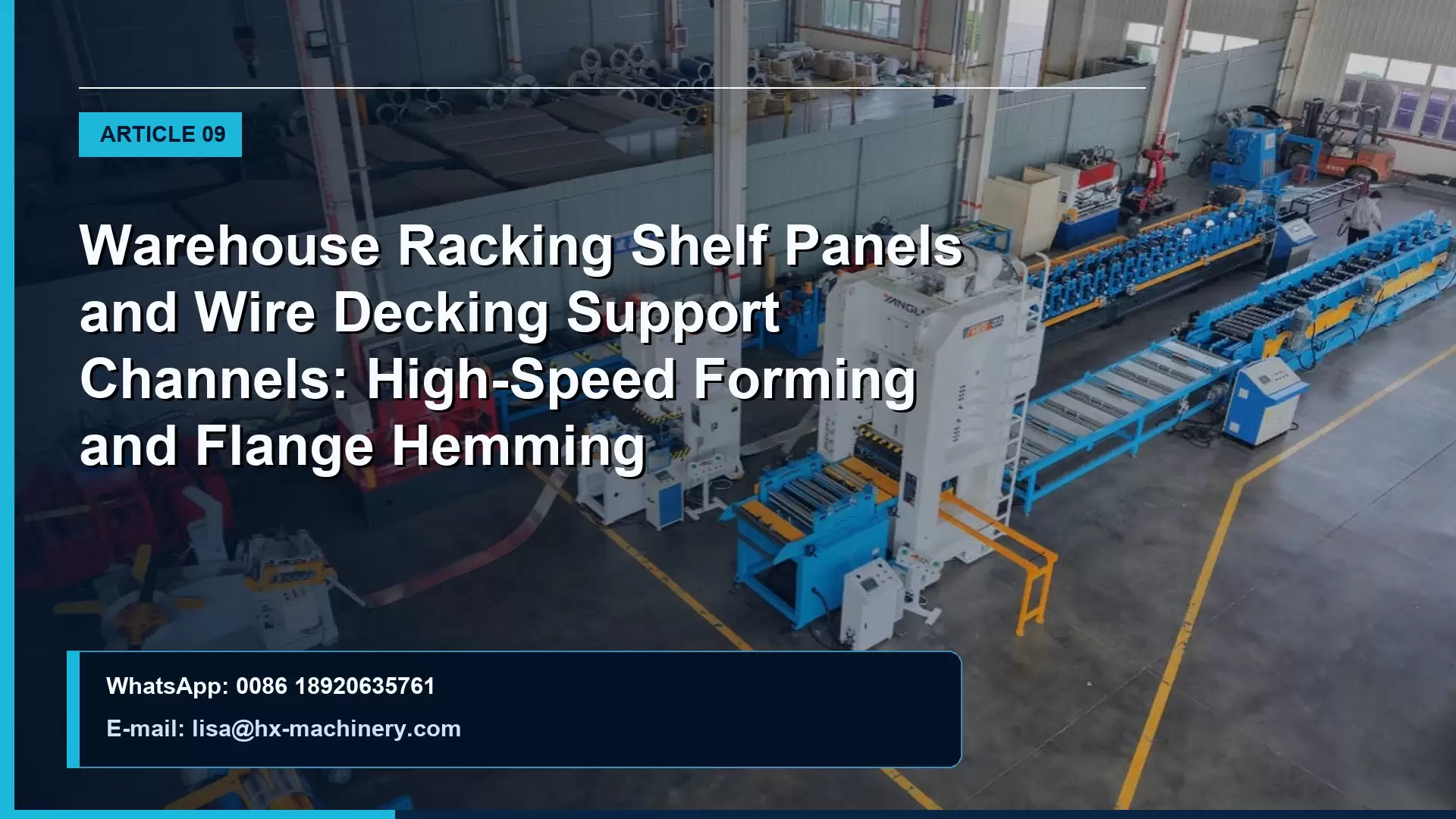
While heavy-duty upright frames and horizontal load beams form the structural skeleton of a pallet rack system, warehouse operators frequently require solid shelf decking to support split-case picking, carton storage, and non-palletized cargo. In modern logistics facilities, two secondary cold-formed components are manufactured in millions of linear meters annually: Roll Formed Steel Shelf Panels (Decking Plates) and Drop-In Hat-Channel Decking Supports.
For equipment buyers and fabricators, adding high-speed shelf decking lines represents a high-margin expansion that complements core upright and beam operations.
1. Component Types: Steel Shelf Panels vs. Hat-Channel Supports
- Solid / Perforated Steel Shelf Panels: Snap over pallet rack beams to provide a smooth, flat deck surface. Typical dimensions: widths of 200 mm to 300 mm, lengths from 800 mm to 1,200 mm, and thickness from 0.7 mm to 1.2 mm galvanized or pre-painted steel.
- Hat-Channel (Omega) Decking Supports: Welded underneath wire mesh decking or laid across beam steps to reinforce particleboard or steel mesh shelves. Typical thickness ranges from 1.2 mm to 2.0 mm.
2. The Flange Hemming and Safety Return Bend Challenge
A key quality benchmark for commercial steel shelf panels is edge safety. In order-picking operations, warehouse workers slide their bare hands along shelf edges thousands of times per shift. Exposed raw sheared steel edges cause laceration hazards.
- The Hemming Solution: Advanced shelf panel roll forming lines integrate continuous 180-degree hem bends along both longitudinal edges. The flat sheet edge is bent 90 degrees, flattened into a teardrop hem, and tightly crimped against the flange.
- Roll Tooling Precision: Executing a tight 180-degree hem on galvanized steel without cracking the zinc coating or inducing longitudinal edge waviness requires progressive roller passes with fine angular increments. HOPEX utilizes precision CNC-machined Cr12MoV tool steel rollers with polished forming grooves that gently curl the sheet edges smoothly.
3. Automatic Notching, Stamping, and Width Flexibility
Shelf panels must incorporate notched corner reliefs to allow the panel flanges to nest flush against beam uprights:
- Pre-Notching & Punching: Coils feed through an automated hydraulic punch unit equipped with multi-station notch tooling that stamps out corner tabs and ventilation slots before entry into the forming stands.
- Width Adjustability: To accommodate multiple shelf depths (e.g., 800 mm, 1,000 mm, 1,200 mm) on a single production line, HOPEX designs its shelf decking machines with motorized dual-side movable stands. Operators can adjust panel width via a simple touchscreen HMI command in under three minutes, avoiding hours of manual spacer reconfiguration.
4. Inline Stacking and Turnkey Packaging Integration
Because light-gauge shelf panels are produced at rapid speeds up to 25 to 35 m/min, manual offloading is impossible. HOPEX lines integrate high-speed magnetic or vacuum-arm automatic stackers that flip alternating panels, nesting them tightly into bundled packs ready for automated plastic strapping and palletizing.
Discover our full range of storage rack roll forming machinery on our official website. Learn about HOPEX's manufacturing excellence, browse our complete equipment catalog, or contact our technical sales engineers to configure a customized shelf panel roll forming line.
