



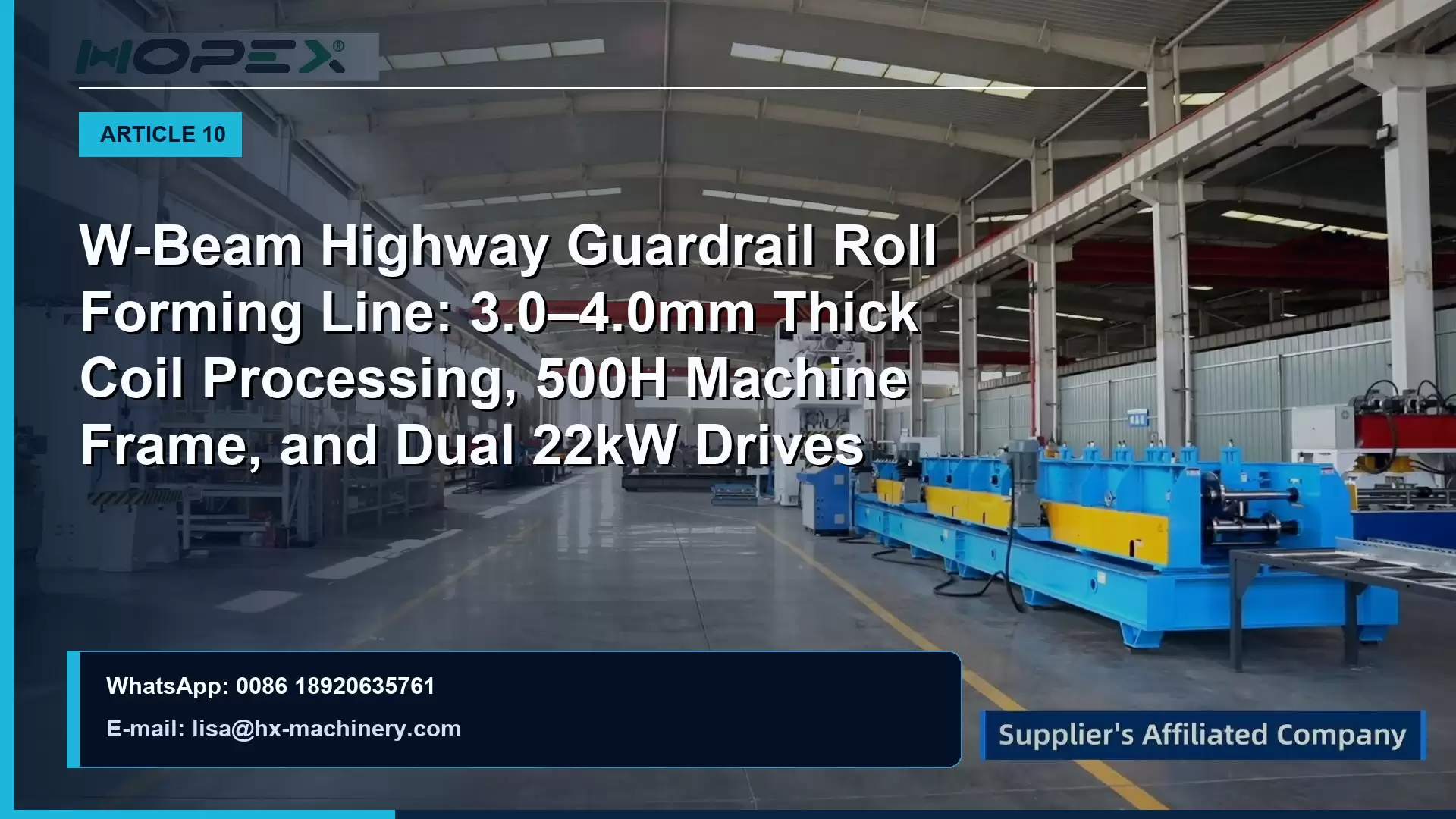
Highway crash safety barriers—specifically standard W-Beam (two-wave) corrugated guardrails—are vital life-safety infrastructure installed along hundreds of thousands of highway kilometers globally. In the event of a high-speed vehicle impact, the corrugated W-beam section acts as a dynamic tension ribbon: it absorbs kinetic energy through plastic deformation while safely redirecting the vehicle along the roadway direction.
However, from an equipment builder's perspective, cold roll forming 3.0 mm to 4.0 mm thick structural steel coils (such as Q235B, S235JR, or ASTM A36) into deep 85 mm corrugations presents immense mechanical challenges that quickly destroy lightweight roll forming machines.
1. Extreme Forming Resistance and Machine Stand Engineering
Rolling a 465 mm wide, 4.0 mm thick steel strip into deep W-wave corrugations generates separation forces exceeding 30 to 45 metric tons across the main forming passes.
- The Catastrophic Failure of Light Machines: Many low-cost machine builders assemble guardrail lines on 300H or 350H welded beam frames with wall-plate stands. Under sustained production torque, light frames deflect, roller shafts bend, and finished guardrails emerge with severe edge wave, longitudinal camber, and out-of-tolerance wave depths.
- The HOPEX Heavy-Duty Architecture: Our two waves highway guardrail roll forming machine is built on an ultra-rigid 500H structural steel bed frame, stress-relieved via thermal annealing to eliminate residual welding stresses. The side stands are fabricated from solid cast iron memorial archway blocks with thick hardened guide caps, guaranteeing zero measurable deflection under full forming tonnage.
2. Shaft Diameter, Roller Metallurgy, and Power Transmission
- Shaft Engineering: Shafts are precision-machined from forged 40Cr or 42CrMo alloy steel, quenched and tempered to HB 260–280, with a massive diameter of Ø85 mm to Ø100 mm. This ensures zero elastic shaft deflection during high-pressure forming passes.
- Roller Tooling: Rollers are machined from genuine Cr12MoV vacuum-quenched tool steel hardened to HRC 60–62, followed by CNC contour grinding and hard chrome plating (≥0.05 mm thickness). This prevents roller galling and withstands abrasive scale from hot-rolled steel strip over millions of linear meters.
- Dual 22 kW Drive System: While standard roll formers use a single small motor, HOPEX guardrail lines employ a dual 22 kW electric motor configuration coupled to heavy-duty industrial reduction gearboxes. High-torque drive shafts deliver balanced rotational power directly to every forming station, eliminating chain stretch, gear chatter, and sheet slipping.
3. Online Punching and AASHTO M-180 Bolt Hole Precision
Standard highway guardrail requires slotted splice bolt holes (typically 20×29 mm and 20×45 mm ovals) at precise 380 mm or 507 mm pitch spacing to allow on-site bolting with overlap splices.
- Punching Station: A high-rigidity 60-to-100-ton hydraulic punch station equipped with precision guide pillars and Cr12MoV punch dies punches all bolt slots simultaneously while the flat strip passes through the leveler.
- Tolerance Compliance: Optical rotary encoders ensure hole pitch spacing meets strict AASHTO M-180 and EN 1317 tolerance requirements within ±0.5 mm, ensuring effortless alignment during field installation on highway posts.
4. Heavy-Duty Hydraulic Cut-Off and Automatic Run-Out
Shearing a deep 3.0 mm to 4.0 mm W-beam profile requires a custom-contoured high-pressure hydraulic shear die. The HOPEX flying shear clamps the corrugated profile from both sides, executing clean, distortion-free shears with minimal burr. Finished beams are delivered onto heavy pneumatic or motorized stacking tables.
Visit our official homepage to discover our complete industrial roll forming capabilities. Learn about HOPEX's two decades of engineering heritage, explore our complete product catalog, or contact our technical sales team to discuss machine pricing and technical specifications.
