



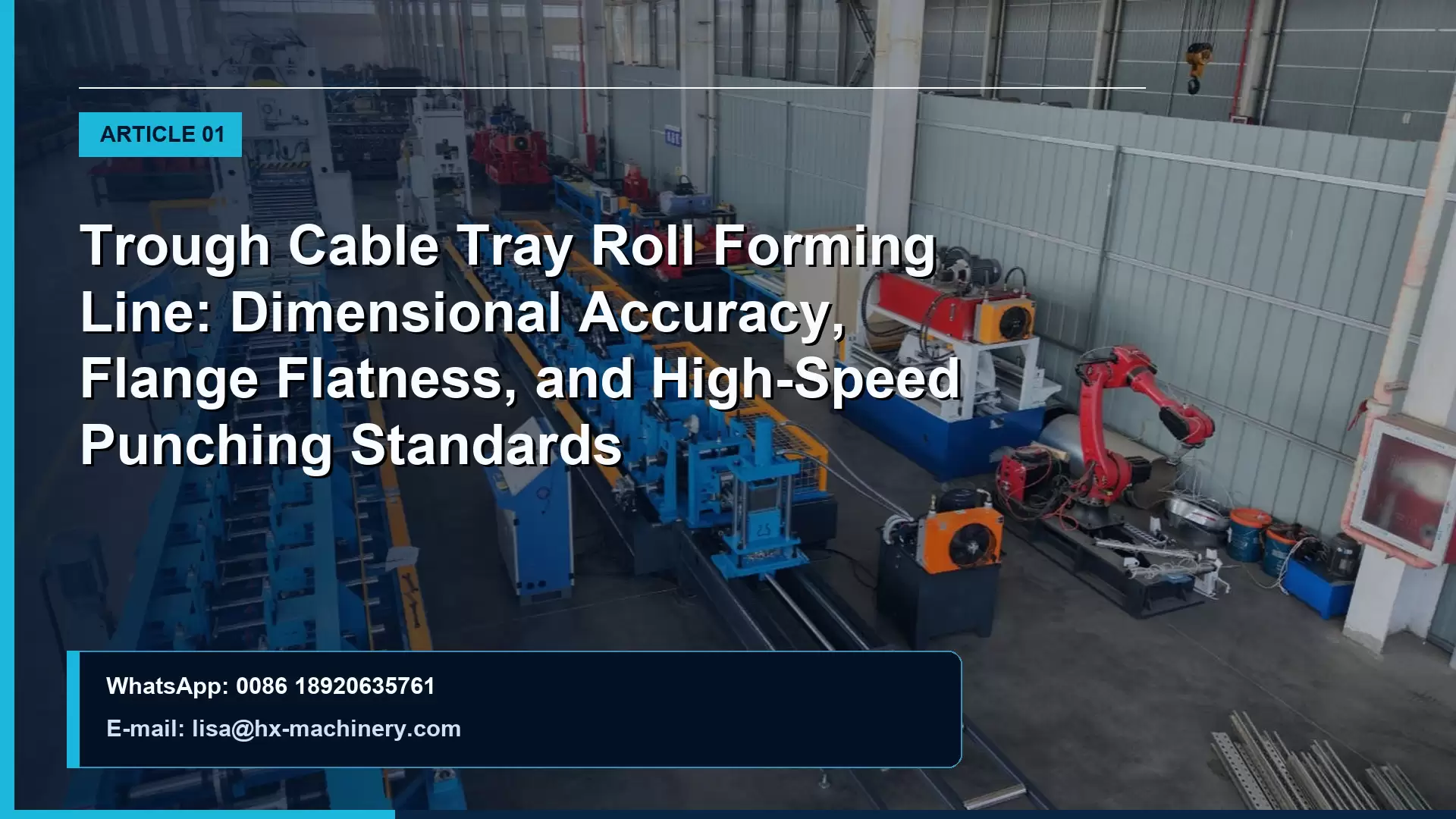
In modern commercial and industrial infrastructure, cable trays serve as the arterial conduits protecting power transmission, data backbones, and control circuits. Among all configurations, the trough-type (solid-bottom or lightly perforated) cable tray is prized for its superior electromagnetic shielding, dust protection, and structural rigidity. However, for manufacturers operating roll forming equipment, producing deep-trough sections with wide base plates and vertical side flanges introduces severe engineering challenges: edge wave, longitudinal bowing, and flange distortion.
1. Overcoming the High-Aspect-Ratio Forming Challenge
A standard trough cable tray typically spans widths from 100 mm to 600 mm, with sidewall heights between 50 mm and 150 mm, fabricated from galvanized steel coils ranging from 0.8 mm to 2.0 mm in thickness. When bending a flat sheet into a U-shaped trough, the plastic deformation is concentrated entirely along the two bend corners, while the central bottom plate undergoes elastic tension and compression.
If the forming station passes are spaced too aggressively, severe transverse oil canning (puckering of the bottom plate) and flared top flanges occur. Professional cable tray machinery requires an incremental deformation approach:
- Station Count: 18 to 24 progressive forming stations to gradually shape the 90-degree corner radii without stressing the web sheet.
- Side Roller Support: Dedicated vertical side-roll tooling units positioned at intermediate and finishing stages to lock the side flanges strictly perpendicular to the bottom web.
- Pass Progression: Utilizing flower-pattern CAD simulation (COPRA or similar) to ensure the neutral axis of the strip remains balanced along the horizontal center passline.
At HOPEX, our trough type cable tray machine incorporates modular cantilevered stands and precision-machined side-roll fixtures, allowing width adjustments from 100 mm to 600 mm without needing an entirely new set of roll tooling.
2. High-Speed Synchronized Online Punching
Ventilated troughs and bottom mounting slots require high-density hole patterns. Conventional offline mechanical punch presses throttle throughput and generate excessive burrs. Modern high-volume lines integrate high-tonnage hydraulic or servo-driven online punching systems:
- Tooling Steel: Punch pins and die plates machined from premium Cr12MoV vacuum heat-treated tool steel hardened to HRC 60–62, preventing edge chipping even after millions of punching cycles.
- Burr Control: Punch-to-die clearance maintained precisely within 6% to 8% of sheet thickness to eliminate sharp burrs that could strip cable insulation during on-site installation.
- Servo Pitch Control: Independent servo feeding mechanisms guarantee hole center-to-center pitch repeatability within ±0.15 mm over an entire 6-meter tray section.
3. Flying Hydraulic Cut-Off and Straightness Assurance
Traditional stop-to-cut systems induce inertia shock, reduce line efficiency by up to 40%, and cause blade wear marks on finished ends. HOPEX equips its lines with a track-mounted flying hydraulic shear driven by high-response servo motors. The cutting blade profile matches the trough section contours, executing clean, distortion-free shears while the profile moves at line speeds up to 15 m/min. Integrated multi-roll Turks-head straighteners positioned at the machine exit correct any residual twist or camber, ensuring the finished profiles slide effortlessly into standard splice connectors.
As a specialized manufacturer with over two decades of heavy machinery fabrication, HOPEX engineers every production line to meet international CE and ISO9001 standards. Discover our complete lineup of roll forming systems by exploring our product categories, or contact our technical sales engineers to configure a customized cable tray production line tailored to your regional market standards.
