



The global warehouse racking market has grown significantly alongside the e-commerce boom, and with it the demand for racking components that meet increasingly rigorous structural specifications. Whether you are already manufacturing racking components or evaluating entry into this market, this technical reference covers every component in a standard selective pallet racking system — what it is, what it must do, and what production quality standards it must meet.
The Five Core Components of Selective Pallet Racking
1. Uprights (Vertical Columns)
The structural backbone of every racking bay. Uprights carry the full vertical load of the stored goods — from a few hundred kilograms in light-duty retail racking to 30 tonnes or more per column in heavy-duty industrial systems.
Profile geometry: Most commonly a punched C-section or Omega-section with a regular hole pattern (50 mm or 75 mm pitch) running the full length for beam connector engagement.
Material standard: Q235B (minimum yield 235 MPa) for light-to-medium duty; Q345B (minimum yield 345 MPa) for heavy-duty and seismic applications.
Dimensional tolerance: Hole pitch ±0.3 mm (critical — cumulative error over 6 m cannot exceed ±1.5 mm); profile height/width ±0.5 mm; straightness ≤1 mm/m.
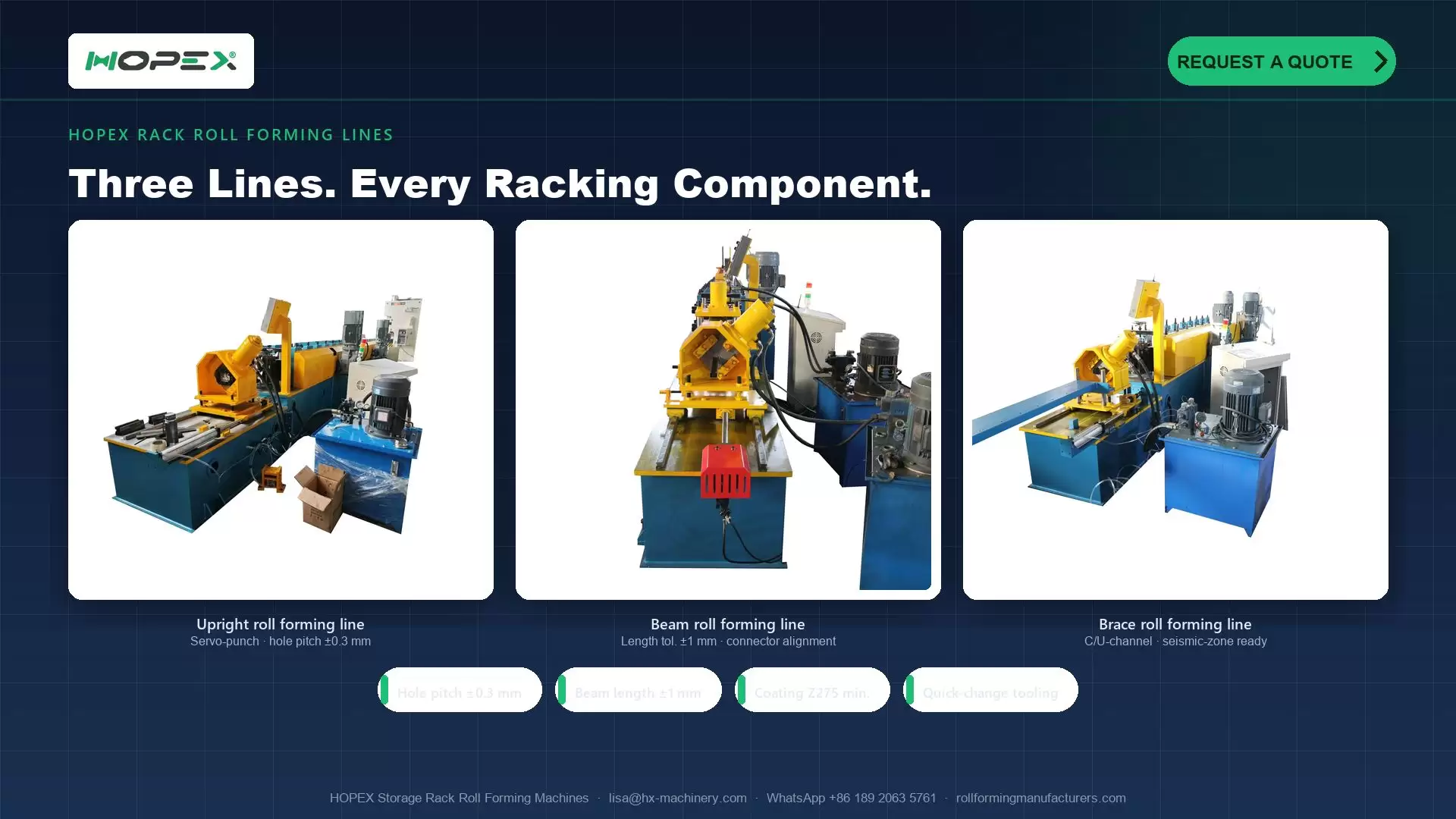
Production method: Upright roll forming machine with integrated servo-driven punch. HOPEX Upright Roll Forming Machine with pre-punch or in-line punch options.
2. Beams (Horizontal Load Members)
Beams connect pairs of uprights and support the pallets or stored loads. Beam deflection under load is the primary structural failure mode — deflection at mid-span must not exceed L/180 (where L is beam span) under design load.
Profile types:
- Step-beam (open C-section with welded end connectors): standard for most selective racking
- Box-beam (welded closed section): higher torsional stiffness, used in heavy-duty and automated storage
Connector type: Hook-type connectors (claws) that engage the upright hole pattern. Safety pins or bolts prevent accidental disengagement.
Dimensional tolerance: Length ±1 mm (critical for connector engagement); end connector alignment ±0.3 mm.
3. Diagonal and Horizontal Braces (Frame Bracing)
Bracing connects the uprights within a frame, providing lateral stability against horizontal forces: forklift impacts, seismic loads, and wind loads in outdoor racking installations.
Profile: Simple C or U-channel; sometimes with stiffening embossments for higher slenderness ratios.
Connection: Bolt-through connection at each end to upright web or flange.
Why it is not a commodity: In seismic zones (California, Japan, New Zealand, Chile), frame bracing must be designed and tested to resist defined horizontal force levels. Manufacturers targeting these markets must ensure their brace profiles and connection details meet local seismic standards.
4. Row Spacers and Rear Ties
These connect adjacent rows of racking at the rear, maintaining row spacing and providing additional lateral restraint in the depth direction of the racking bay.
Profile: Simple tubular or channel section.
Importance: Often underspecified and underbought — but critical for the overall stability of multi-row racking installations.
5. Baseplates
The connection point between each upright and the floor anchors. Baseplates must transfer both vertical compression loads and horizontal shear forces from the bracing system into the floor anchor bolts.
Material: Hot-rolled steel plate, typically 6–12 mm thick; welded or bolted to the upright foot.
Connection to floor: Chemical anchor bolts or expansion anchors, with embedment depth and bolt specification determined by the upright design load.
Standard Load Capacities and What They Mean for Production
Racking manufacturers typically offer products in standardized load classes:
For each class, the structural profile dimensions and material grades change. A production line capable of switching between classes requires quick-change roll forming tooling — this is one of the most commercially valuable features of a flexible rack roll forming machine.
For more on production economics by component and volume, see our article Rack Roll Forming Machine ROI Calculator and our detailed component production breakdown in Rack Roll Forming Machine | Storage Rack Production Equipment.
Quality Testing Requirements for Racking Components
Dimensional inspection: 100% length and connector alignment verification for beams; statistical sampling for uprights and braces.
Load testing: Beam deflection testing at design load (typically 1.5× rated UDL) for every new profile design before commercial production.
Surface coating inspection: Coating weight verification (minimum Z275 for indoor applications) from mill certificates, with spot-check verification via X-ray fluorescence (XRF) or weigh-strip-reweigh method.
Hole pitch verification: Optical measurement or gauge pin check for upright hole pitch — this is the most commonly failed inspection point in racking production.
Bringing It Together: Your Production Strategy
If you are entering or expanding in the racking market, two questions define your production strategy:
-
Which load classes will you target? Light-to-medium: a single flexible line may suffice. Heavy-to-very-heavy: dedicated lines for uprights and beams, potentially with integrated connector welding.
-
Which geographies will you sell into? Each major market (EU, US, Australia, seismic zones) has specific standards. Equipment that cannot meet the tolerance requirements of those standards limits your market access.
Explore our Rack Roll Forming Machine product range or contact our technical team with your target product specification for a consultation. We also have an About HOPEX overview on our homepage for background on our capabilities and global track record.
