



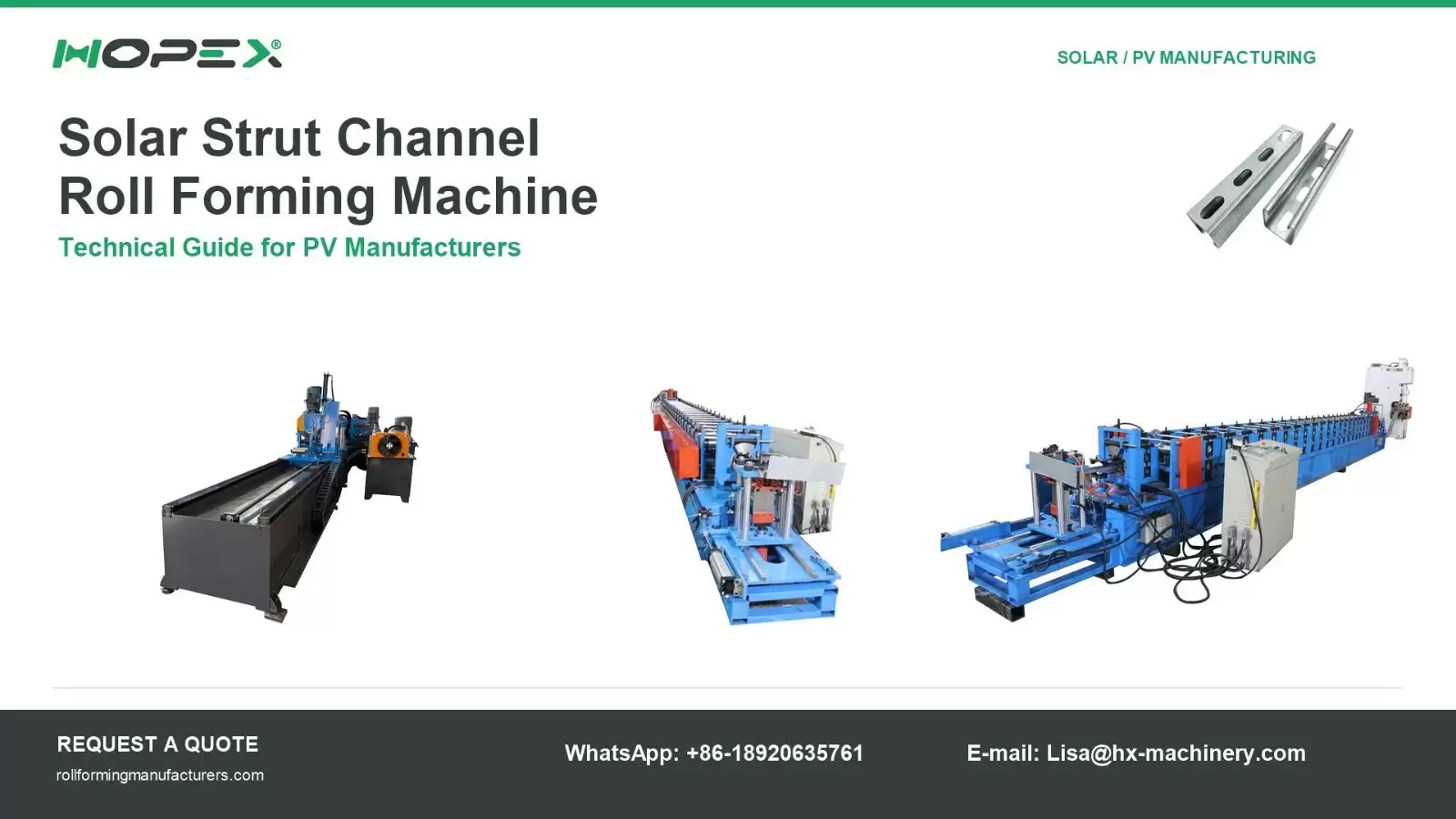
The global solar energy market is expanding at a compound annual growth rate exceeding 15%. Behind every photovoltaic installation — from a 10 kW rooftop array to a 500 MW utility farm — is a steel mounting structure. And behind every mounting structure is a roll forming machine.
This article is written for manufacturers, contractors, and procurement professionals who are evaluating solar strut channel roll forming machine options. We cover profile types, machine configurations, production speeds, material requirements, and key purchase criteria.
The Role of Solar Strut Channels in PV Systems
Solar strut channels are the structural backbone of photovoltaic mounting systems. They bear the combined dead load of the panels, wind uplift and pressure, snow loads, and — in seismic zones — dynamic earthquake forces. A channel that is dimensionally inconsistent or structurally weak will compromise the entire installation.
The channels are typically produced in three primary profiles:
C-Channel (Open Section): The most widely used profile, characterized by its inward-curled lips that allow bolt heads to slide freely along the channel length. This makes C-channels ideal for applications where panel tilt adjustment is required during installation. Standard dimensions: 41 mm × 41 mm, 41 mm × 21 mm, or custom sizes.
U-Channel (Open Top): A simpler rectangular profile without lips. Higher torsional stiffness than C-channel, used where structural rigidity takes priority over adjustability. Common in ground-mount rail systems.
Omega / Hat Section: A closed-top profile that provides excellent resistance to both axial and lateral loads. Used primarily in rooftop ballasted systems and BIPV (building-integrated photovoltaics) applications.
Machine Configuration for Solar Strut Production
A professional solar strut channel roll forming line includes the following stations:
1. Hydraulic Uncoiler Capacity: 5–10 tons coil weight. Hydraulic mandrel expansion for tool-free coil mounting. Auto-tension control maintains consistent strip tension throughout the coil.
2. Precision Leveling Unit 7-roller or 11-roller leveling eliminates coil curvature and internal stress. Critical for achieving straight channels — a curved channel cannot be corrected after forming.
3. Servo Punching Station Programmable servo-driven punching creates the characteristic hole pattern in solar strut channels. Key specs:
- Hole diameter: 9–14 mm (standard), custom available
- Hole pitch: 25 mm, 50 mm (standard), programmable
- Punching force: 50–200 kN depending on material and pattern
- Die material: Cr12MoV with TiN coating for extended life
4. Roll Forming Section The forming section progressively shapes the flat strip into the final channel profile through 12–20 stations of incremental bending. Each station contributes a defined amount of deformation, distributing the forming force and preventing cracking or springback.
Roller specifications at HOPEX:
- Material: Cr12MoV, hardened to HRC 60–62
- Shaft diameter: 50–70 mm depending on material thickness
- Machining: CNC grinding to ±0.02 mm tolerance
5. Hydraulic Cut-Off Flying shear or fixed stop cut-off. For continuous production without speed interruption, the flying shear synchronized with the forming speed is recommended for lines above 20 m/min.
6. Discharge Table / Auto Stacker Servo-driven length measurement → automatic stacking by count or weight.
Production Speed and Output Benchmarks
Output figures assume 90% uptime efficiency. Actual values depend on coil change intervals, operator efficiency, and changeover frequency.
Material Selection for Solar Channels
The choice of base material directly affects corrosion resistance, structural performance, and manufacturing cost:
Hot-dip galvanized steel (HDG): The industry standard. Zinc coating Z100–Z275 provides 20–40 years of corrosion resistance depending on environment. Most compatible with standard roll forming tooling.
Pre-painted galvanized steel (PPGI): Used where aesthetics matter (commercial rooftops, BIPV). The paint coating requires coated roller surfaces or low-contact-pressure roll forming to prevent surface damage.
Stainless steel (304/316): Used in coastal or chemically aggressive environments. Requires carbide-coated rollers and reduced forming speed. Material cost 3–5× higher than galvanized steel.
Aluminum alloy (6005-T5, 6063-T6): Growing adoption in utility-scale projects due to reduced weight and inherent corrosion resistance. Requires aluminum-specific roll tooling to prevent galling.
Key Purchase Criteria for Buyers
When evaluating solar strut channel roll forming machine suppliers, prioritize these factors:
- Profile match: Can the supplier produce your exact C/U/Omega profile dimensions with documented tolerance records?
- Punching precision: Is hole pitch accuracy ±0.3 mm or better? Inconsistent hole pitch creates assembly problems at scale.
- Changeover capability: If you produce multiple profiles, what is the actual changeover time between C-channel and U-channel?
- Servo vs. mechanical punching: Servo-driven systems are 30–50% faster on changeovers and offer superior programmability.
- After-sales engineering: For overseas buyers, on-site commissioning and remote support availability are critical.
HOPEX solar strut channel roll forming machines are deployed in solar manufacturing facilities across Southeast Asia, the Middle East, and Latin America. View our solar structure machine range or contact us for a tailored specification.
Return on Investment Analysis
For a manufacturer producing 50,000 meters of solar strut channel per month:
Figures are indicative. Actual costs vary by region and material prices.
Conclusion
For any manufacturer or installer entering the solar mounting structure market, in-house production of strut channels offers a compelling economic case and operational advantage. The critical step is selecting a roll forming machine supplier with proven experience in your exact profile, traceable material specifications, and genuine after-sales support.
Explore HOPEX solar structure machines or send us your profile drawings for a tailored quotation.
