



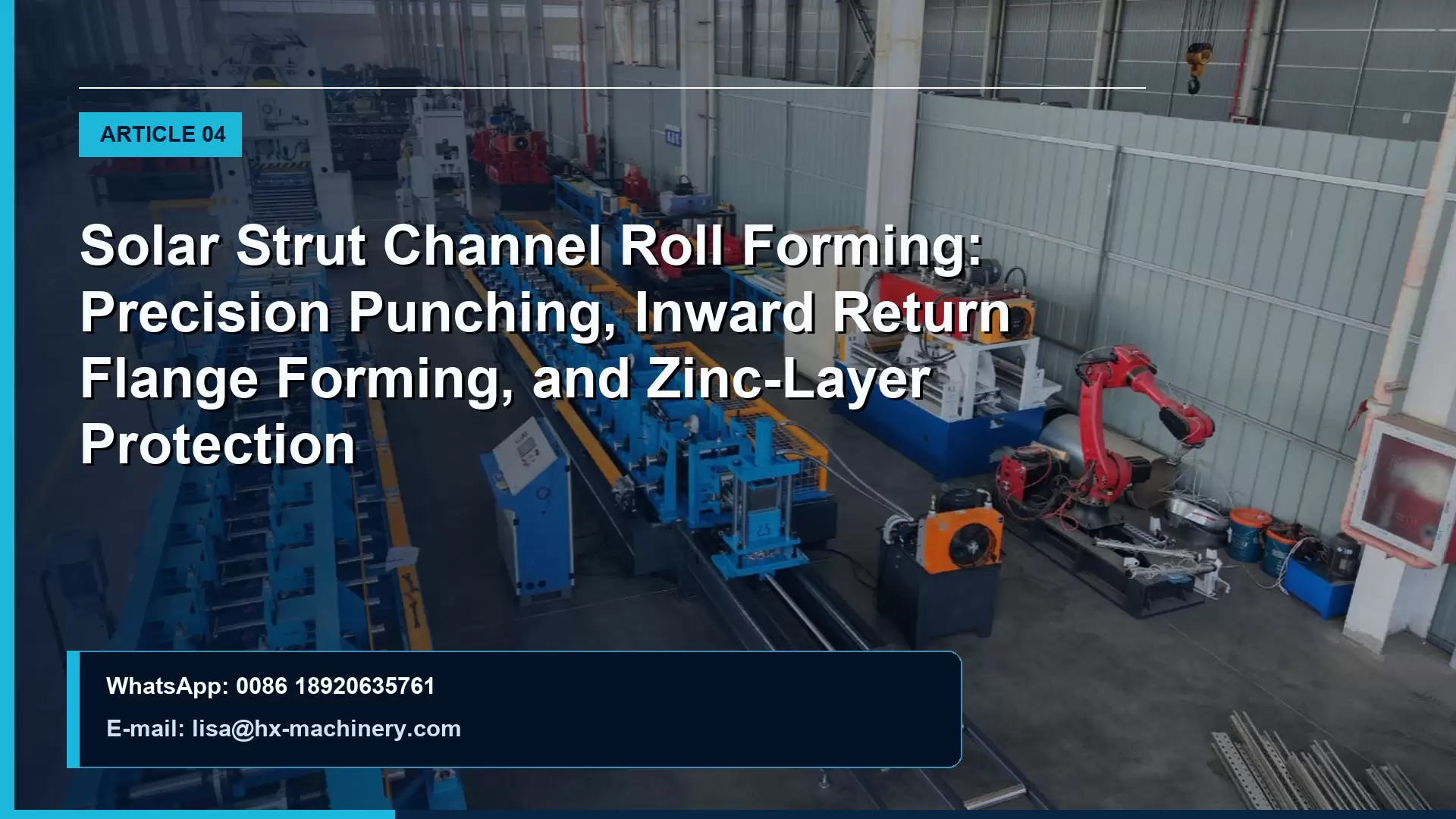
Photovoltaic mounting systems are deployed in some of the most unforgiving environments on Earth—from scorching desert solar farms exposed to intense UV and abrasive sandstorms to corrosive offshore coastal arrays. The cold-formed steel strut channels (frequently designated as 41×41 mm, 41×21 mm, or 41×62 mm C-channels) serve as the primary racking rails supporting solar panels.
Fabricating these structural channels requires strict adherence to profile tolerances, precise hole pitch repeatability for quick-clamp hardware, and absolute protection of galvanized coatings during high-speed cold roll forming.
1. Forming the Inward Return Flange Without Cracking
The defining feature of a structural strut channel is its inward-curled lips (return flanges). These lips feature serrated grooves or flat return edges designed to lock channel spring nuts into place under high wind uplift loads.
- The Cold-Work Hardening Problem: Bending structural galvanized steel (such as S350GD, S420GD, or ASTM A653 Grade 50) through multiple tight angles work-hardens the steel rapidly. If the inside bend radius is too sharp or the angle progression per station is too steep, micro-cracks develop along the zinc layer and parent metal.
- The HOPEX Multi-Stage Solution: Our solar strut channel roll forming machine employs 16 to 20 precision-designed forming passes. Dedicated pre-bending and auxiliary side-roll passes guide the return lip inward smoothly, maintaining uniform material flow and preventing stress concentration.
2. Zinc Coating Protection on Z275 and Zn-Al-Mg Alloys
Solar EPCs increasingly mandate high-durability coatings, transitioning from standard hot-dip galvanized Z275 steel to advanced Zinc-Aluminum-Magnesium (Zn-Al-Mg / ZAM) alloys that provide self-healing corrosion resistance. However, Zn-Al-Mg coatings are softer and more prone to galling and roller pickup.
- Roller Material and Finish: Standard hardened carbon steel rollers will pick up microscopic zinc particles, creating abrasive mounds on the roller surface that scratch subsequent profiles. HOPEX utilizes premium Cr12MoV vacuum-quenched tool steel hardened to HRC 60–62, followed by high-precision CNC mirror grinding (surface roughness Ra ≤ 0.4 μm) and hard chrome or PVD micro-coating.
- Lubrication Cooling: Integrated emulsion mist cooling flushes away loose zinc dust and minimizes friction-induced heat, ensuring the finished strut channels exit the line with an unblemished, fully intact protective barrier.
3. Servo-Driven Punching and High-Precision Hole Patterns
Solar channels require continuous slotted or round hole patterns along their base to accommodate ground mounting hardware and module clamps.
- The Critical Tolerance: A cumulative pitch error of even 0.5 mm over a single meter results in misalignment on long 6-meter rail strings, stalling solar installers in the field.
- Servo Synchronization: The HOPEX PV mounting equipment solar bracket roll forming machine features a high-speed servo-driven mechanical or hydraulic punch press positioned before the roll forming mill. Optical rotary encoders paired with Omron or Siemens PLCs maintain individual hole pitch tolerances within ±0.2 mm, while cumulative pitch variation across a 6,000 mm rail is locked under ±1.0 mm.
4. Turnkey Automation and Industry 4.0 Integration
High-capacity solar bracket plants operate on thin margins where cycle times determine profitability. HOPEX lines integrate automatic hydraulic uncoilers with coil cars, loop accumulators for uninterrupted operation, flying shear cutoff units, and automatic cantilevered stacking arms.
Visit the HOPEX homepage to discover our full range of cold roll forming technologies. Learn about our company history and manufacturing facilities, explore our complete product line catalog, or contact our technical sales engineers to review custom profile drawings and machinery configurations.
