



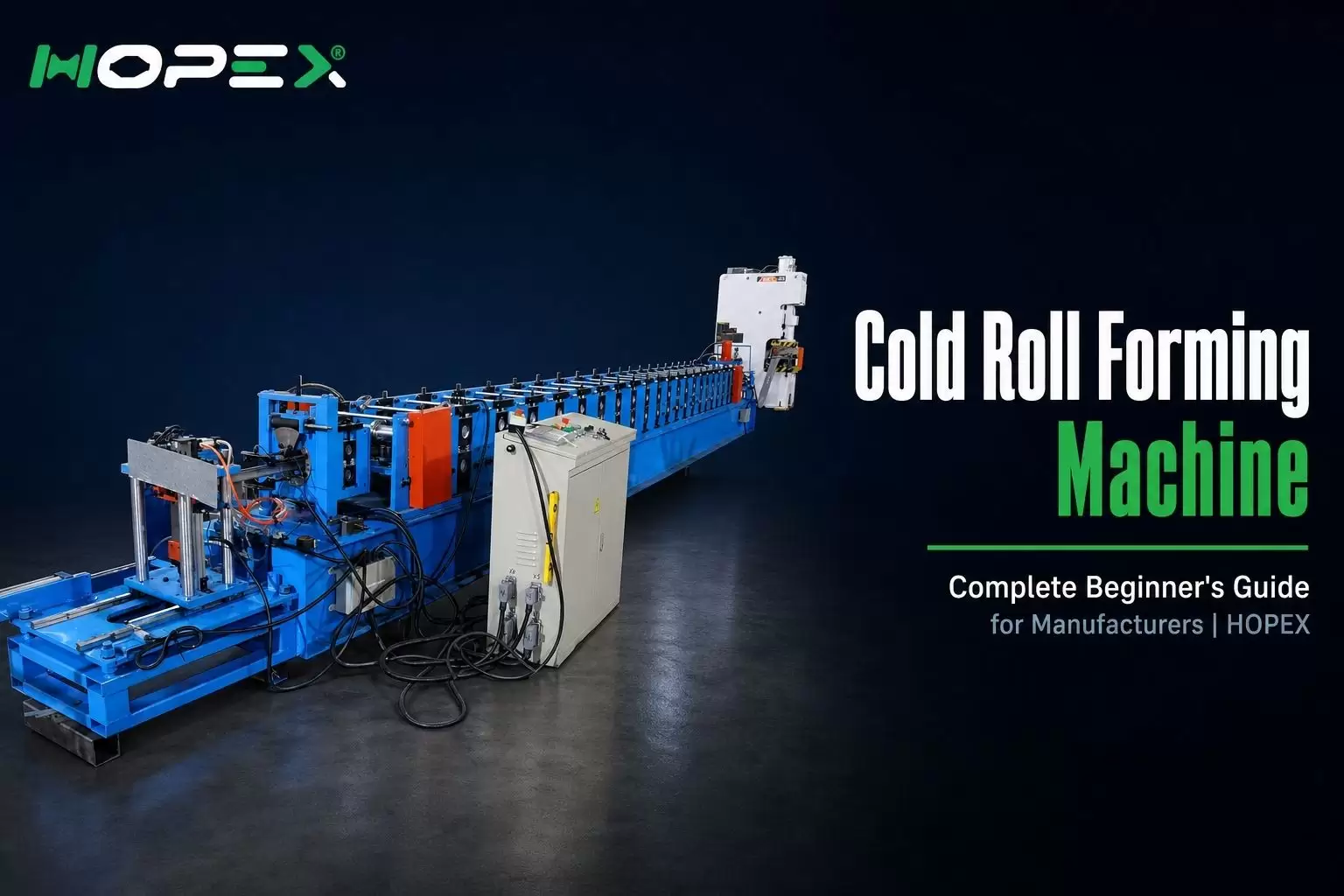
Cold roll forming is one of the most productive and capital-efficient metal forming technologies in industrial manufacturing — but for engineers and entrepreneurs approaching it for the first time, the learning curve can feel steep. The terminology is specific, the process variables are numerous, and the equipment market is populated by suppliers whose capabilities vary enormously.
This guide gives you a clear, jargon-free introduction to cold roll forming: what it is, how it works, what it produces, and how to evaluate whether it is the right technology for your manufacturing objectives.
What Is Cold Roll Forming?
Cold roll forming is a continuous metalworking process in which a flat metal strip — fed from a coil — is progressively formed into a complex cross-section profile by passing through a series of roll stations. Each station adds one or more bends to the strip, with the cumulative effect of all stations producing the final profile geometry.
"Cold" distinguishes this process from hot rolling, which requires heating the metal. Cold roll forming is performed at room temperature, which:
- Preserves the material's surface coating (galvanizing, paint, anodizing) without damage
- Produces work-hardening in the formed area, slightly increasing yield strength
- Requires no energy-intensive heating equipment
- Produces profiles with tight dimensional tolerances and good surface finish
How the Process Works — Step by Step
Step 1: Coil Loading
A metal coil (typically 0.8–6.0 mm thick steel or aluminum, 200–1500 mm wide) is loaded onto a decoiler (uncoiler). The decoiler holds the coil and pays out strip at a controlled tension.
Step 2: Leveling
The strip passes through a leveler — a series of opposing rollers that remove the coil set (curvature from being wound on the coil). Proper leveling is essential: any residual curvature becomes profile bow or twist in the finished product.
Step 3: Pre-Punching (if required)
For profiles that need holes at specific positions (cable tray perforation, racking upright hole patterns, guardrail bolt holes), a punching station located before the forming section creates these holes in the flat strip before it is formed. This is called "pre-punching" — the alternative is "post-punching" (punching after forming), which is more complex.
Step 4: Roll Forming
The heart of the process. The strip passes through a sequence of roll stations — typically 8–24 stations for industrial profiles. Each station consists of a pair of profiled rollers (top and bottom) that contact the strip and apply bending forces to shape a specific portion of the profile.
The design of the roll station sequence (the "flower pattern") determines how the flat strip transitions to the final profile through intermediate formed shapes. Good flower pattern design minimizes material stress, maintains dimensional accuracy, and allows for quick roll set changeover.
Step 5: Sizing (Optional)
A final set of sizing rolls (also called "calibration rolls") corrects any minor dimensional variation introduced during the main forming sequence. Common for precision profiles where tight tolerance is required on every dimension.
Step 6: Cutting
The continuously formed profile is cut to the required length. Two methods:
- Hydraulic stop-and-cut: production stops briefly for each cut — simpler, lower cost, introduces a small dead time per cut
- Flying shear / flying cut-off: the cutting mechanism travels with the moving profile, cutting without stopping production — faster, higher capital cost, essential for high-speed lines
What Materials Can Be Cold Roll Formed?
Any ductile metal that can be formed without cracking at room temperature is a candidate for cold roll forming:
What Profiles Can Be Produced?
Cold roll forming produces any profile whose cross-section can be achieved by progressively bending a flat strip. Common categories:
- C and U channels: used in structural framing, cable trays, racking beams
- Z and sigma sections: used in purlins and structural cladding support
- Omega profiles: used in solar mounting rails, wall panels
- Closed sections: square or rectangular hollow sections (formed from a strip and then the edges are welded or locked together)
- Complex multi-bend profiles: cable tray sidewalls with multiple steps, guardrail profiles with two or three corrugations
Profiles that cannot be cold roll formed: those with varying cross-section along the length (tapered profiles), and those with geometry features only achievable by stamping or machining.
The Economics of Cold Roll Forming
The economics of roll forming are characterized by high fixed costs (tooling and machine) and very low variable costs per unit. This means:
- Low volume: roll forming is not cost-effective (high tooling cost amortized over few units)
- High volume: roll forming becomes the lowest-cost production method by a significant margin
For the products we specialize in at HOPEX — cable trays, solar mounting rails, racking components, and highway guardrails — annual production volumes are in the thousands to millions of meters, firmly in the range where roll forming economics are highly favorable.
Is Roll Forming Right for Your Product?
Use this quick checklist:
✅ Constant cross-section along the full profile length
✅ Linear profile (not a short stamped part)
✅ Annual volume exceeds 5,000 meters (or 50,000 pieces for short profiles)
✅ Material thickness in the range 0.5–6.0 mm
✅ Ductile material (steel, aluminum, stainless)
✅ Surface coating that must be preserved during forming
If you check three or more of these boxes, cold roll forming is likely the right technology for your application.
For a consultation on your specific profile and volume requirements, contact HOPEX. You can also explore our product lines on the HOPEX homepage to see the range of applications we support.
