



Most buyers receive wildly different quotes for the same roll forming machine — not because suppliers are dishonest, but because the request for quotation (RFQ) they sent was incomplete, ambiguous, or open to interpretation. When a supplier can interpret your requirements loosely, they will quote a machine that meets their standard offering rather than your actual needs.
This guide gives you the RFQ structure and specific questions that will get you accurate, comparable quotes — and that will immediately reveal suppliers who cannot meet your requirements.
Why Roll Forming Machine RFQs Go Wrong
A typical buyer's RFQ says something like:
"We need a cable tray roll forming machine for producing trays 200–600 mm wide, 1.0–2.5 mm thick, galvanized steel."
This gives the supplier almost no useful information. They do not know:
- What profile geometry (what shape is the sidewall, what is the base perforation pattern?)
- What production speed you need (and whether you mean rated or actual)
- What cut length tolerance is required
- What PLC brand and interface language you need
- Whether CE marking or other certification is required
- What your local power supply is (380V/50Hz? 415V/60Hz?)
- What your after-sales support requirement is
- When you need delivery
Without this information, every supplier quotes their standard configuration. The lowest quote is always the one that assumed the most favorable interpretation of every ambiguity.
The 8-Section Roll Forming Machine RFQ Template
Section 1: Product Specification (The Profile)
This is the most important section. Include:
- Profile drawing with all critical dimensions labeled (width, height, flange length, sidewall angle, corner radii)
- Material: type (galvanized steel, stainless, aluminum), grade (Q235B, Q345B, 304SS, 6061 aluminum), and coating specification
- Material thickness range: minimum, maximum, and most common
- Cross-section sketch or DXF file — if you can, include a physical sample
Why it matters: Suppliers size the machine frame, drive power, and roll station count based on the profile geometry and material. Without this, every specification is a guess.
Section 2: Production Requirements
- Target production speed (meters per minute, actual not rated)
- Target daily output (meters per shift, shifts per day)
- Cut length range and tolerance (e.g., 3–6 m, ±1 mm)
- Punch pattern if required (hole size, hole pitch, pattern drawing)
Section 3: Automation and Control
- PLC brand preference (Mitsubishi, Siemens, Delta, etc.)
- Operator interface: touchscreen HMI, language requirement
- Recipe storage: how many product variants does the machine need to store?
- Remote access: is remote PLC diagnostics required?
- Level of automation: manual coil loading vs. auto-feeding vs. full turnkey?
Section 4: Electrical Standards
- Local power supply: voltage, frequency, phase
- Electrical safety standard: CE (EU), UL (US), or local equivalent
- Motor protection standard: IP55 or IP65?
Section 5: Physical Constraints
- Available floor area (length × width, minimum aisle clearances)
- Available headroom (for coil crane loading)
- Foundation specification: existing concrete floor rating, or new foundation to be designed
Section 6: Certification and Documentation
- Product certification required (CE, AASHTO, etc.)
- Machine certification required (CE Machinery Directive, UL, etc.)
- Documentation language requirement
- Spare parts list requirement
Section 7: Commercial Terms
- Required delivery location (port of discharge or factory address)
- Target delivery date
- Payment terms (LC, T/T, etc.)
- Incoterms preference (FOB, CIF, DDP)
Section 8: Supplier Qualification Questions
These questions separate serious suppliers from catalogue sellers:
- Can you provide a video of a machine producing this exact profile at the quoted production speed?
- What is the steel grade and hardness specification of your roll tooling?
- What is the warranted dimensional tolerance on the critical profile dimensions?
- Who is the PLC and servo system supplier? Provide the model numbers.
- What is the standard warranty period and what is excluded?
- Can you provide references from customers producing the same or similar profile?
- What is your installation and commissioning process for overseas orders?
- What spare parts do you recommend purchasing with the machine, and what is their current lead time?
Reading the Quotes: Red Flags and Green Flags
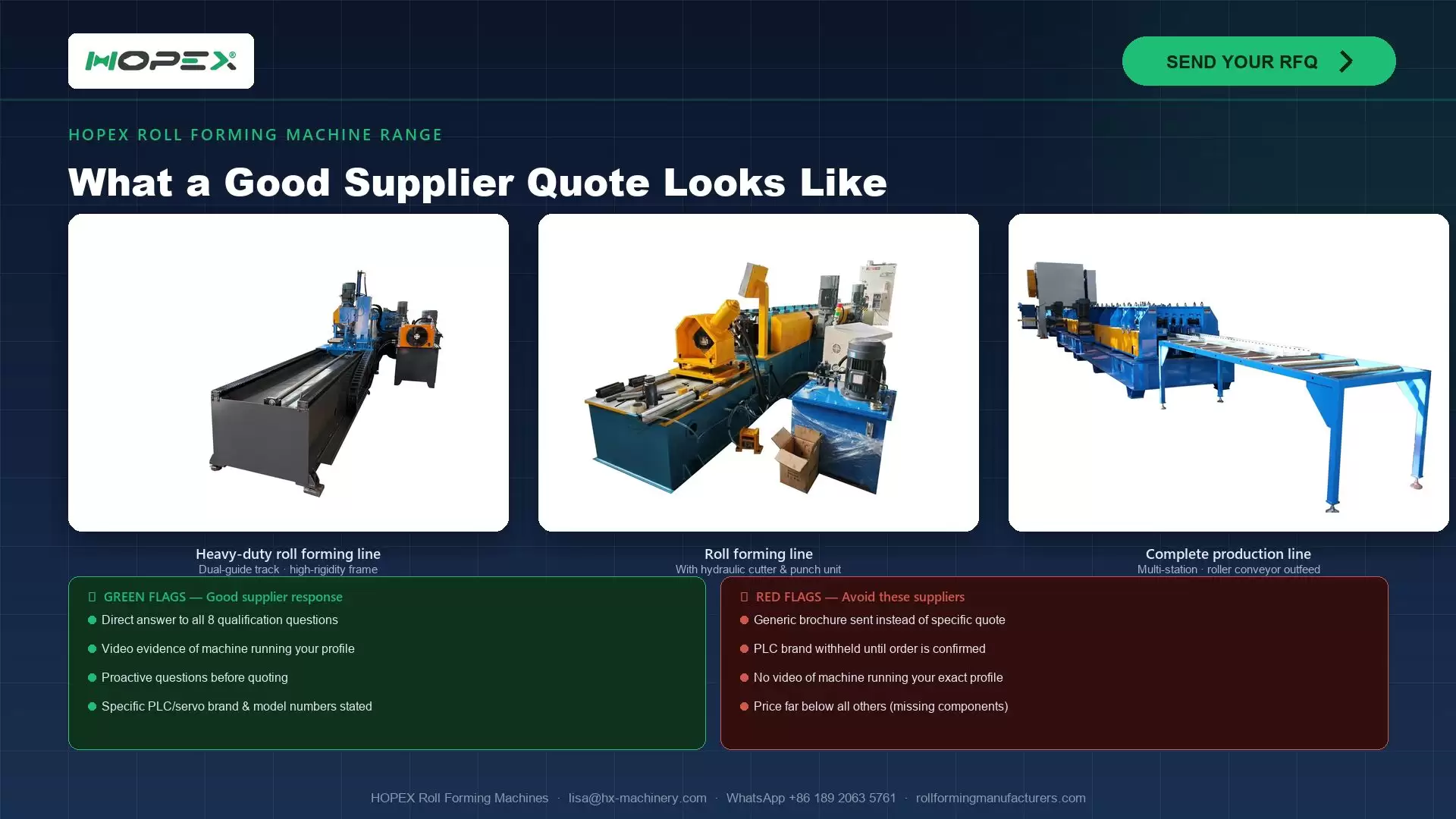
Green flags in a supplier response:
- Direct answer to every Section 8 question, with video evidence and specific technical commitments
- Proactive questions about your profile and production requirements before quoting
- References to specific customers they can introduce
- A clear statement of what is and is not included in the quoted price
Red flags:
- Generic brochure sent in response to a specific RFQ
- Refusal to name the PLC or servo brands until "order is confirmed"
- No video evidence of the machine running your profile
- Price significantly below all other quotes (usually means something is missing)
- Warranty limited to "components not caused by operator error" — a clause that enables them to reject almost any claim
For background on what a complete roll forming production line should include, our article on Roll Forming Machine Maintenance Best Practices is useful reading — it gives you an engineer's perspective on the components that matter for long-term reliability.
Next Step: Get a Quote from HOPEX
If you are ready to send an RFQ, contact our team with your profile drawing and production requirements. We respond to all technical inquiries within 24 hours with a detailed response — not a generic brochure.
You can also review our product range on the HOPEX homepage to see which product families we specialize in before submitting your requirements.
