



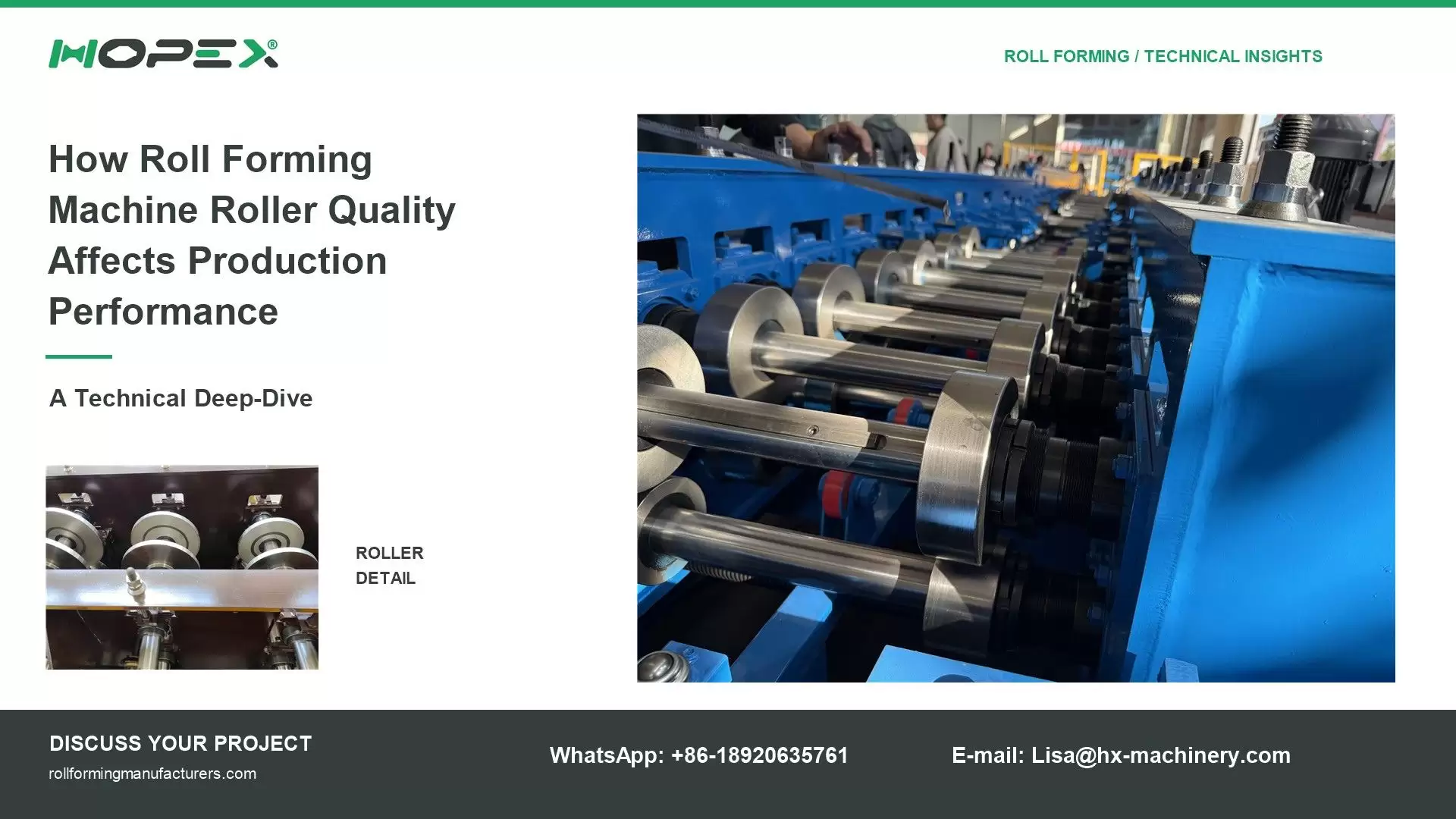
In a roll forming machine, the rollers are the most critical — and most frequently compromised — component. They determine dimensional accuracy, surface finish quality, production speed capability, and machine service life. Yet many buyers focus on overall machine price while paying insufficient attention to roller specifications.
The Role of Rollers in the Forming Process
Roll forming works by incrementally bending flat metal strip through a series of paired roller stations. Each station contributes a defined amount of deformation. The rollers are in constant contact with the workpiece at every production meter, sustaining:
- Compression loads from bending the material
- Abrasion from the moving steel strip surface
- Impact loads from material defects, coil splices, and weld seams
- Thermal cycling from friction-generated heat during high-speed production
A roller that cannot maintain its geometry under these conditions will progressively produce worse dimensional accuracy — and the operator will chase the problem indefinitely through adjustments, never solving the root cause.
The Roller Material Hierarchy
Grade 1 — 45# Carbon Steel (Unacceptable for Production) Surface hardness after heat treatment: HRC 45–50. Used only in demonstration machines and extremely low-volume applications. Deforms under production load within weeks. Never specify this for a production machine.
Grade 2 — GCr15 Bearing Steel Surface hardness after heat treatment: HRC 58–62. The minimum acceptable grade for standard roll forming applications. Excellent fatigue resistance. Adequate for light-gauge material (≤2.0 mm) at moderate production speeds.
Grade 3 — Cr12MoV Tool Steel (Industry Benchmark) Surface hardness after heat treatment: HRC 60–62. The preferred material for all professional roll forming tooling. Superior wear resistance, higher toughness than GCr15, better resistance to edge chipping. Recommended for all applications above 2.0 mm material thickness and for high-speed lines.
Grade 4 — Cr12MoV with TiN or CrN PVD Coating The highest-performance option. The PVD coating (typically 3–5 μm thick) adds hardness (HV 2,000–3,000) and reduces friction coefficient. Significantly extends service life for high-speed lines, abrasive materials, and stainless steel or aluminum forming.
At HOPEX, all production machines use Cr12MoV rollers as standard, with PVD-coated options available for high-speed and specialty material applications.
Shaft Specifications: The Supporting Structure
Shaft diameter is also critical. Undersized shafts deflect under forming load, causing the roller gap to open on one end — resulting in profile dimensions that vary from one edge to the other. For cable tray lines (up to 2.0 mm material), a minimum shaft diameter of 55 mm is typical. For guardrail lines (3.0–4.0 mm material), 70–80 mm shafts are standard.
Machining Precision: The Dimensional Foundation
- Roller outer diameter tolerance: ±0.02 mm (CNC grinding required; lathe-only machining cannot achieve this)
- Roller width/shoulder position: ±0.05 mm (determines profile width accuracy)
- Surface finish: Ra 0.4–0.8 μm (polished surface reduces material drag and friction marking)
- Concentricity (runout): ≤0.01 mm TIR
Rollers meeting these specifications will produce consistent profiles across millions of production meters.
How to Evaluate Roller Quality When Purchasing
When you receive a quotation for a roll forming machine, ask the supplier:
- What roller material do you use? (Accept: Cr12MoV or GCr15 with documented hardness test certificate)
- What is the roller hardness after heat treatment? (Accept: HRC 58–62)
- How are rollers machined? (Accept: CNC grinding; lathe-only is insufficient)
- What is the roller diameter tolerance? (Accept: ±0.02 mm or better)
- Can you provide roller material/hardness certificates? (A quality supplier will; evasion is a red flag)
The True Cost of Poor Roller Quality
Consider a cable tray roll forming line running at 8 m/min, 16 hours/day, 250 days/year:
- Annual output: approximately 1,920 km of cable tray
- If dimensional drift from worn rollers causes even 2% rejection rate: 38.4 km of wasted product
- At $12/linear meter selling price: $460,800 in annual scrap and rework costs
Against this, the cost premium for Cr12MoV versus 45# steel rollers is trivial. Roller quality is not a cost-cutting area.
Roller Service Life Expectations
Cr12MoV rollers on a standard cable tray / solar channel line (1.5–2.0 mm galvanized steel):
- Expected service life before regrinding: 2,000–5,000 hours
- Regrind tolerance: rollers can typically be reground 2–3 times before replacement
- Total service life per roller set: 6,000–15,000 production hours
Guardrail lines (3.0 mm galvanized steel, higher forming load):
- Expected service life before regrinding: 1,500–3,000 hours
Conclusion
Roller quality is the single most important — and most overlooked — factor in roll forming machine selection. The material grade, heat treatment, and machining precision of the rollers determine not just initial accuracy but the machine's consistent performance over its entire operational life.
View HOPEX's roll forming machine range — all equipped with Cr12MoV rollers as standard. Contact us for roller material certificates and technical documentation.
