



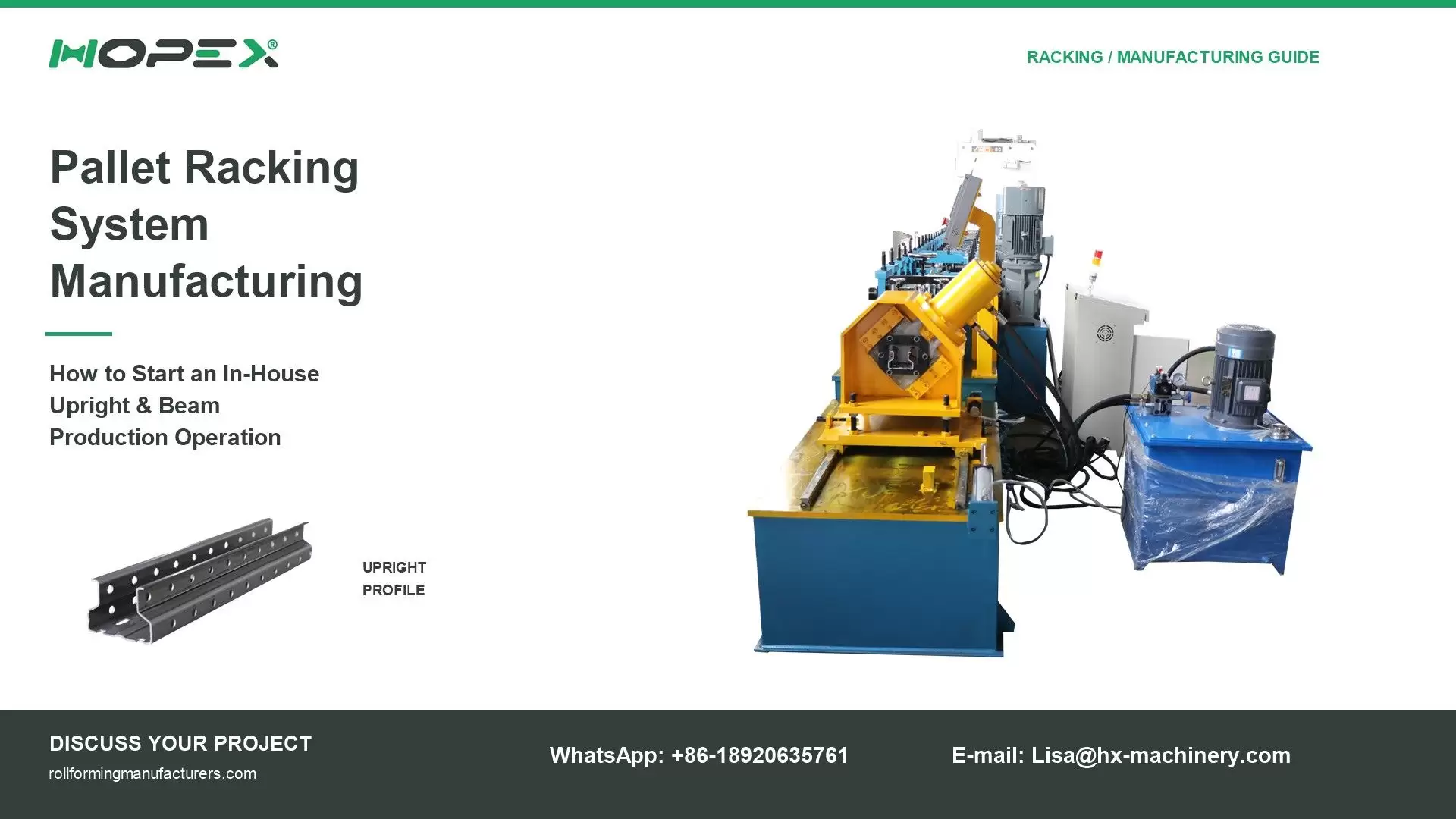
Global e-commerce growth is translating directly into warehouse construction — and warehouse construction drives demand for pallet racking systems. If you're already distributing or installing racking, or if you're a steel fabricator looking for the next high-margin product category, in-house racking component production deserves serious consideration.
The Pallet Racking Market in 2025
The global pallet racking market exceeded $10 billion in 2024 and is growing at approximately 6–8% annually. Key market dynamics:
- Tier 1 e-commerce logistics (Amazon, Alibaba, JD.com) is building fulfillment centers at unprecedented scale, requiring dense racking systems
- Cold chain expansion following the COVID supply chain crisis is driving demand for specialized cold-storage racking
- Seismic-compliant racking for earthquake-prone markets (Japan, Pacific Coast, Turkey, Chile) commands significant price premiums
- Automated Storage and Retrieval Systems (AS/RS) require extremely high dimensional precision — a market niche for quality-first manufacturers
The Four Core Components and Their Manufacturing Sequence
For the detailed technical breakdown of each component, see: Rack Roll Forming Machine | Storage Rack Production Equipment
Step 1: Start with Uprights (Vertical Columns)
Uprights are the highest-value, most complex component. They define your product's load rating and are the component most scrutinized by buyers.
- Machine requirement: Upright roll forming machine with integrated servo punching (hole pitch ±0.3 mm tolerance is non-negotiable)
- Material: Q235B or Q345B, thickness 1.5–3.0 mm
- Critical spec: Hole pitch accuracy ±0.3 mm, profile straightness ≤1 mm/m
Step 2: Add Crossbeams (Horizontal Load Bearers)
Once your upright line is running, adding crossbeam production completes your racking "kit" and significantly improves your cost position.
- Machine requirement: Racking beam roll form machine with automatic end-connector insertion/welding station for production volumes above 500 units/day
- Material: Q235B, thickness 1.2–3.5 mm depending on load class
Step 3: Add Braces (Lateral Stability)
Diagonal and horizontal braces are simpler profiles but produced in high volume.
- Machine requirement: C/U channel roll forming machine with servo length control
- Can often be a smaller, lower-cost line than the upright machine
Step 4: Shelf Decking (Optional)
Most racking manufacturers source shelf decks externally in the early stages and bring production in-house only at significant volume.
Production Layout Planning
Material flow: Steel coil arrives → uncoiling area (crane-accessible) → forming line(s) → cut-to-length → post-processing (end connectors, surface treatment) → finished goods staging → dispatch
Crane requirements: Coils typically weigh 5–15 tons. A 10-ton overhead bridge crane is standard for facilities handling more than 200 tons/month.
Surface treatment: Standard racking is powder-coated or electrostatically painted. Heavy-duty / outdoor / cold-storage racking requires hot-dip galvanizing (typically outsourced in early stages).
Investment Planning: Three Scenarios
Scenario A — Starter Operation
- 1× Upright line + 1× Crossbeam line with end-connector station
- Monthly output: 150–300 tons
- Total equipment investment: $280,000–$450,000
- Payback: 18–30 months
Scenario B — Mid-Scale Facility
- 2× Upright lines + 1× Crossbeam line + 1× Brace/channel line
- Monthly output: 600–1,000 tons
- Total equipment investment: $600,000–$900,000
- Payback: 18–24 months
Scenario C — Full-Scale Racking Factory
- Multiple lines for all components including wire deck welding
- Monthly output: 2,000+ tons
- Full turnkey investment: $2M–$5M
Certifications and Market Requirements
- EN 15512 / EN 15620 (Europe): Structural design requirements; load testing required
- RMI MH16.1 (North America): ANSI standard for industrial steel storage racks
- AS 4084 (Australia): Pallet racking design and testing requirements
- FEM 10.2.02 (international): Used by major logistics operators
Most large buyers (3PL logistics companies, e-commerce operators) require racking load certification before placing orders.
Conclusion
Starting an in-house pallet racking production operation is a significant investment — but one with a clear, proven payback path for manufacturers positioned in growing logistics and warehouse markets. The key is sequencing the investment correctly: start with uprights and crossbeams, build your market reputation for dimensional accuracy, then expand capacity as orders grow.
View HOPEX racking machine solutions including upright lines, beam lines, and complete turnkey racking production systems. Learn about us or contact our engineering team for a production planning consultation.
