



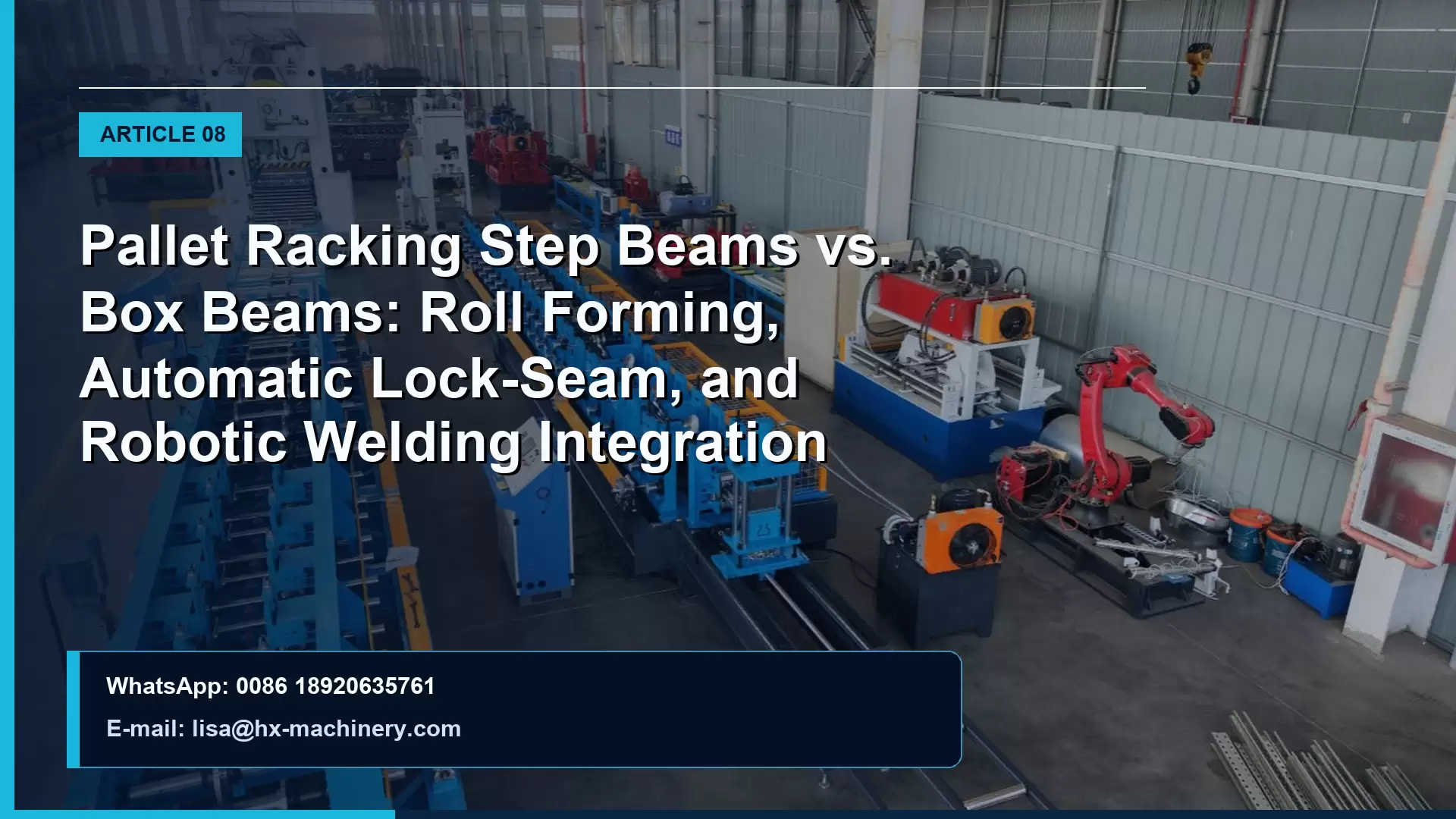
In heavy industrial and commercial warehouse racking, the horizontal crossbeams bear the direct weight of palletized merchandise, transferring vertical loads into the upright columns. Two beam designs dominate global storage engineering: Step Beams (predominantly favored in North America to support drop-in wire decking and wood panels) and Box Beams (widely utilized in European and international pallet storage systems for maximum torsional resistance).
For storage equipment manufacturers, selecting the proper roll forming line architecture, seam-locking technology, and automated connector welding system is crucial to operating a competitive, high-throughput beam production facility.
1. Profile Geometry: Step Beams vs. Box Beams
- Step Beams: Characterized by an L-shaped recessed step along the top inner edge. This step allows standard 38 mm (1.5-inch) wire mesh decking, plywood shelves, or steel shelf panels to drop in flush with the top beam surface. Thickness ranges from 1.2 mm to 2.5 mm.
- Box Beams: Manufactured by interlocking two symmetrical C-sections together, or by cold-forming a single continuous tube with an internal or external continuous lock-seam. Box beams offer uniform moment of inertia in both horizontal and vertical axes, providing superior resistance to lateral buckling under heavy pallet loading. Thickness ranges from 1.5 mm to 3.0 mm.
2. Continuous Inline Lock-Seaming vs. Stitch Welding
Traditional box beam fabrication involved rolling two independent C-channels and manually seam-welding them along both edges—a labor-intensive process prone to thermal distortion and high grinding costs. Modern high-volume beam lines utilize continuous roll forming with automated inline mechanical lock-seaming:
- Mechanical Hemming & Lock-Seam: As the flat strip is formed into a closed rectangular box, specialized rotary seaming rollers fold the mating edges together under high hydraulic pressure, creating an airtight, high-strength structural lock-seam without consuming welding wire or shielding gas.
- Line Speed & Efficiency: A HOPEX racking beam roll form machine production line for storage system operates at speeds up to 20 m/min, cutting manufacturing labor costs by more than 60% compared to traditional manual fabrication.
3. Automatic End-Connector (Claw) Assembly and Robotic Welding
A crossbeam is incomplete without its welded end-connectors (often called connector claws), which feature stamped 3-to-5-prong hook tabs designed to engage with upright column holes.
- Traditional Bottleneck: Manual tack welding and human weld finishing create inconsistent weld penetration and throughput bottlenecks.
- The HOPEX Automated Beam Welding Cell: HOPEX provides turnkey beam production lines that link the roll former directly to an automated end-connector welding station. Formed and cut-to-length beam tubes are transferred via a motorized indexer table into dual-robot welding fixtures. Hydraulic clamps lock the beam and connectors in exact square alignment, while dual FANUC or Yaskawa robotic welding arms execute deep-penetration CO₂/MIG fillet welds on both beam ends simultaneously.
4. International Load Testing and Deflection Standards
Warehouse safety codes—including ANSI/RMI MH16.1 (USA), EN 15512 (Europe), and AS 4084 (Australia)—strictly regulate horizontal beam deflection. Under maximum design pallet load, the mid-span vertical deflection must not exceed 1/200th of the clear bay span length (L/200L/200). Achieving this standard requires high-yield steel and uniform cross-sectional dimensions with zero residual twist.
Visit our official homepage to learn more about our manufacturing capabilities. Explore HOPEX's corporate background, browse our complete product catalog, or contact our technical sales team to configure a high-efficiency racking beam roll forming and robotic welding line.
