



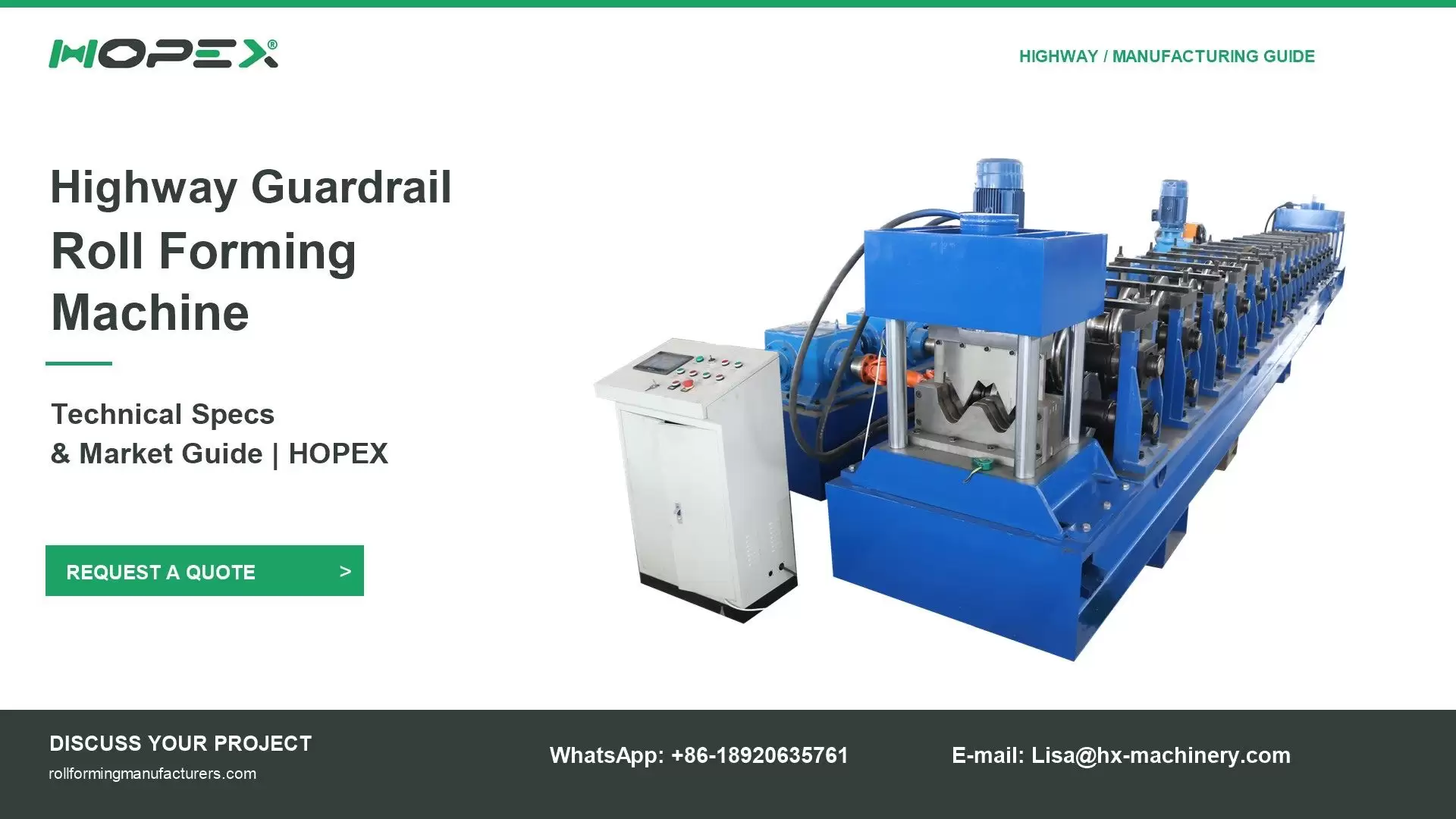
Every year, highway guardrails prevent hundreds of thousands of serious road accidents worldwide. Behind the production of every guardrail section is a precision roll forming machine — and the manufacturers that operate these machines supply one of the most consistent, government-backed infrastructure markets in the world.
Why the Guardrail Market Is Attractive for Roll Forming Manufacturers
Unlike discretionary industrial markets, highway guardrail demand is driven by government infrastructure spending — a category that rarely contracts sharply during economic downturns. Key demand drivers include:
- New road construction: Emerging markets in Southeast Asia, Africa, Central Asia, and Latin America are building hundreds of thousands of kilometers of new roads annually
- Replacement cycles: Guardrails have a service life of 15–25 years, generating steady replacement demand
- Road safety mandates: UN Decade of Action for Road Safety (2021–2030) targets a 50% reduction in road fatalities, driving guardrail upgrades globally
- Infrastructure stimulus packages: Post-COVID fiscal spending in multiple countries has prioritized road safety infrastructure
Guardrail Types and Their Production Requirements
W-Beam (Two-Wave) Guardrail
The global standard for highway safety barriers — the distinctive double-wave cross-section provides controlled deformation on vehicle impact.
- Feed width: 465–475 mm
- Material thickness: 2.0–4.0 mm (most markets: 2.5–3.0 mm)
- Steel grade: Q235B or equivalent (ASTM A36, EN S235)
- Surface finish: Hot-dip galvanized (minimum 600 g/m² for standard guardrail)
- Section length: 3,000 mm, 4,000 mm, or 4,320 mm (market-specific)
- Forming stations: 15–18
- Production speed: 5–15 m/min
Thrie-Beam (Three-Wave) Guardrail
The heavy-duty specification for high-speed highways, bridge approaches, and heavy vehicle corridors. The three-wave profile provides approximately 40% higher energy absorption than W-beam.
- Feed width: 483 mm
- Material thickness: 2.5–4.0 mm
- Machine frame requirement: 500H beam minimum (handles higher forming resistance)
- Forming stations: 15–18 (same count, heavier tooling)
- Production speed: 5–12 m/min
Machine Configuration: Complete Production Line
- Hydraulic Uncoiler (5–10 ton capacity) with auto-tension and coil alignment
- Feeding and Leveling Unit — eliminates coil set before forming
- Punching Station — creates bolt holes at standard pitch (380 mm or 507 mm, market-dependent)
- Roll Forming Section — 15–18 stations with Cr12MoV rollers hardened to HRC 60–62
- Hydraulic Cut-Off — servo-synchronized for clean cuts at production speed
- Run-Out Table with automatic stacking
Power requirements: Dual 22 kW motors standard for most guardrail lines.
Market Entry Considerations
Which standard does your target market use?
- EN 1317 (Europe) — defines performance classes H1–H4b
- AASHTO M-180 (North America) — specifies W-beam geometry and material
- GB/T 31439 (China) — domestic standard
- AS/NZS 3845 (Australia/New Zealand)
The profile geometry differs between standards. Confirm your target market standard before specifying the machine.
Domestic vs. export market? Guardrail is a heavy, low-value-to-weight product. Exporting over 3,000 km is rarely economical. Most successful guardrail manufacturers sell within a 500–1,500 km radius.
ROI Model: W-Beam Guardrail Production
Based on 5 m/min average production speed, 16-hour operation, 300 working days/year:
Why HOPEX for Guardrail Lines
HOPEX has supplied highway guardrail roll forming lines since 2003. Our machines run in government-certified guardrail factories in the Middle East, Southeast Asia, Central Asia, and South America.
- Cr12MoV rollers, hardened to HRC 60–62, CNC precision-ground
- Dual 22 kW drive system
- Delta or Siemens PLC with English/Arabic/Spanish HMI available
- 24-month warranty, remote diagnostics, overseas commissioning
View our guardrail machine range, or contact HOPEX with your target profile standard and production volume for a tailored proposal. Learn more about us.
