



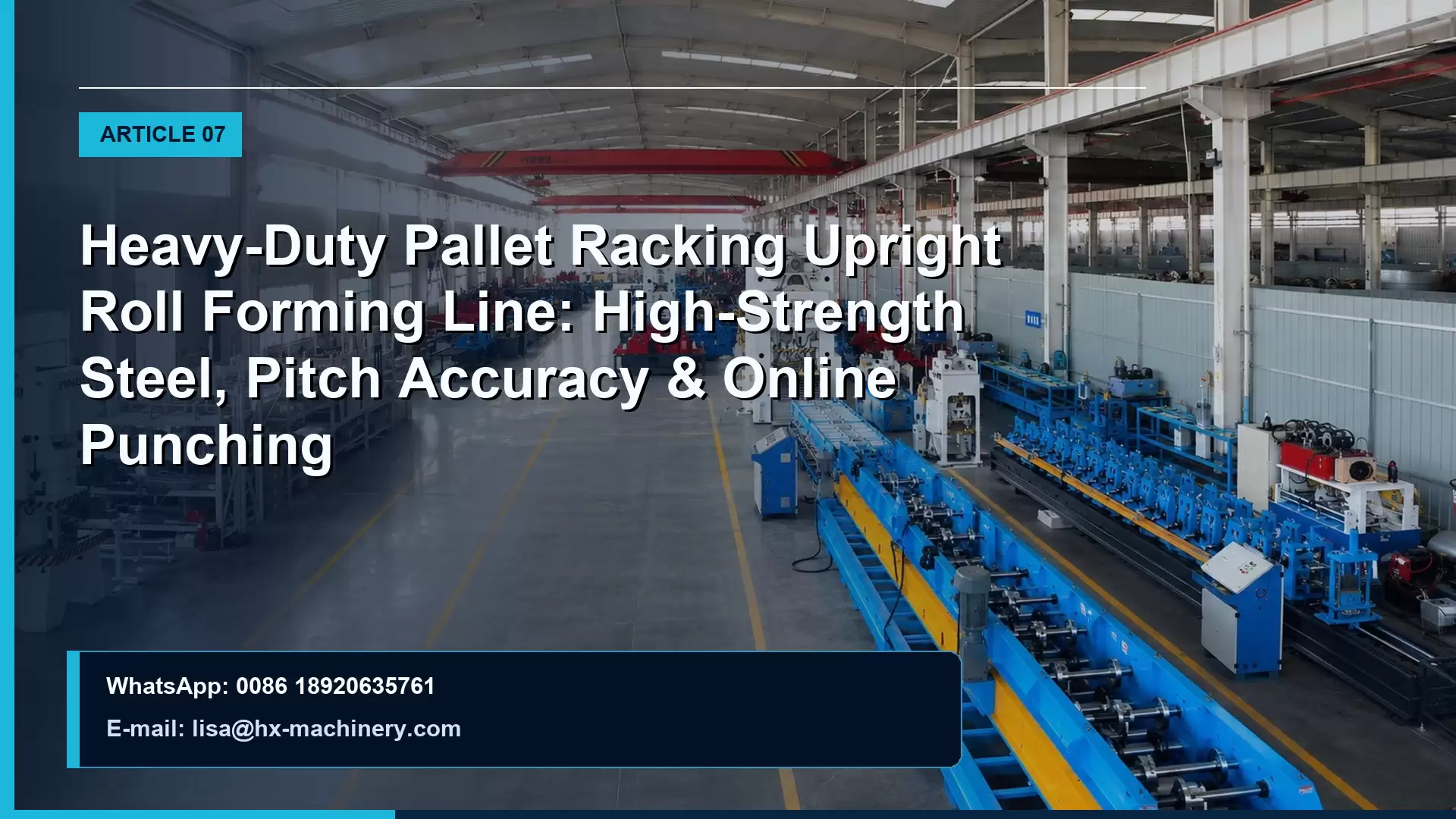
In modern distribution centers and high-density automated warehouses, pallet racking upright frames bear staggering vertical loads—often supporting multi-tier storage reaching 12 to 30 meters in height with rack bay loads exceeding 20,000 kg. The structural integrity of the entire warehouse rests upon the cold-formed steel upright column (often designated as a modified 90×70 mm, 100×70 mm, or 120×95 mm omega-shaped open section).
Producing these columns demands extreme precision. A fraction of a millimeter of cumulative hole pitch deviation across a 12-meter upright will prevent horizontal beams from locking into place, rendering the entire racking assembly unusable.
1. Complex Omega Upright Geometry and Forming Dynamics
A professional racking upright is not a simple C-channel. It incorporates multiple structural bends:
- Multi-Bended Flanges and Return Lips: Typically features 8 to 14 distinct longitudinal bend corners designed to maximize the moment of inertia and prevent local torsional-flexural buckling under axial compressive load.
- High-Strength Steel Forming: Modern racking designs utilize structural steels such as Q345B, Q420, S355MC, or ASTM Grade 50. High-yield steel exhibits pronounced springback behavior. If the forming pass design fails to account for this elastic recovery, the finished column's throat dimension will open up, preventing beam connector tabs from engaging.
- HOPEX Station Progression: Our automatic upright roll forming machine manufacturer system utilizes 22 to 26 forming passes. Dedicated over-bending and side-calibrating passes lock the upright profile into strict dimensional tolerance, keeping throat width variations within ±0.25 mm.
2. High-Precision Servo Punching for Teardrop and Butterfly Slots
Racking uprights are characterized by continuous vertical columns of mounting holes—most commonly teardrop, butterfly, or diamond patterns spaced at exact 50 mm, 75 mm, or 76.2 mm (3-inch) pitch increments.
- The Stamping Challenge: Stamping thousands of precision holes in 2.0 mm to 3.0 mm high-strength steel coil before roll forming creates localized sheet stretching. If uncorrected, this stretching introduces longitudinal camber and twist during the subsequent forming passes.
- The HOPEX Mechanical Punching Cell: HOPEX integrates a high-rigidity 100-to-160-ton continuous mechanical power press or synchronized multi-cylinder servo hydraulic station. Punch pins and die inserts are machined from SKD11 or Cr12MoV vacuum-quenched tool steel (HRC 60–62). High-precision rotary servo feeders paired with optical scale feedback maintain center-to-center hole pitch accuracy within ±0.1 mm, with cumulative pitch error across a 12-meter column strictly constrained below ±0.5 mm.
3. Flying Hydraulic Cut-Off and Burr-Free Edges
Uprights must be cut to custom lengths (often spanning 3 to 14 meters) without edge flaring or distortion around the hole patterns. HOPEX implements a servo-driven flying hydraulic shear. The cut-off die features an external and internal segmented blade system that shears the multi-bend profile smoothly while the line operates at speeds up to 15 m/min. The resulting cut edges are flat, burr-free, and perpendicular within 0.5 degrees.
4. Turnkey Factory Integration and AS/RS Standards
Automated Storage and Retrieval Systems (AS/RS) require tighter tolerances than traditional forklift-loaded racks. Automated crane shuttles operate with clearance envelopes measured in millimeters. The HOPEX upright rack roll forming machine provides the stability and repeatable dimensional accuracy required to supply AS/RS projects worldwide.
Visit our homepage to discover our comprehensive machinery portfolio. Learn about HOPEX's engineering capabilities and factory track record, explore our complete product categories, or contact our technical sales team to configure a customized racking upright production line.
