



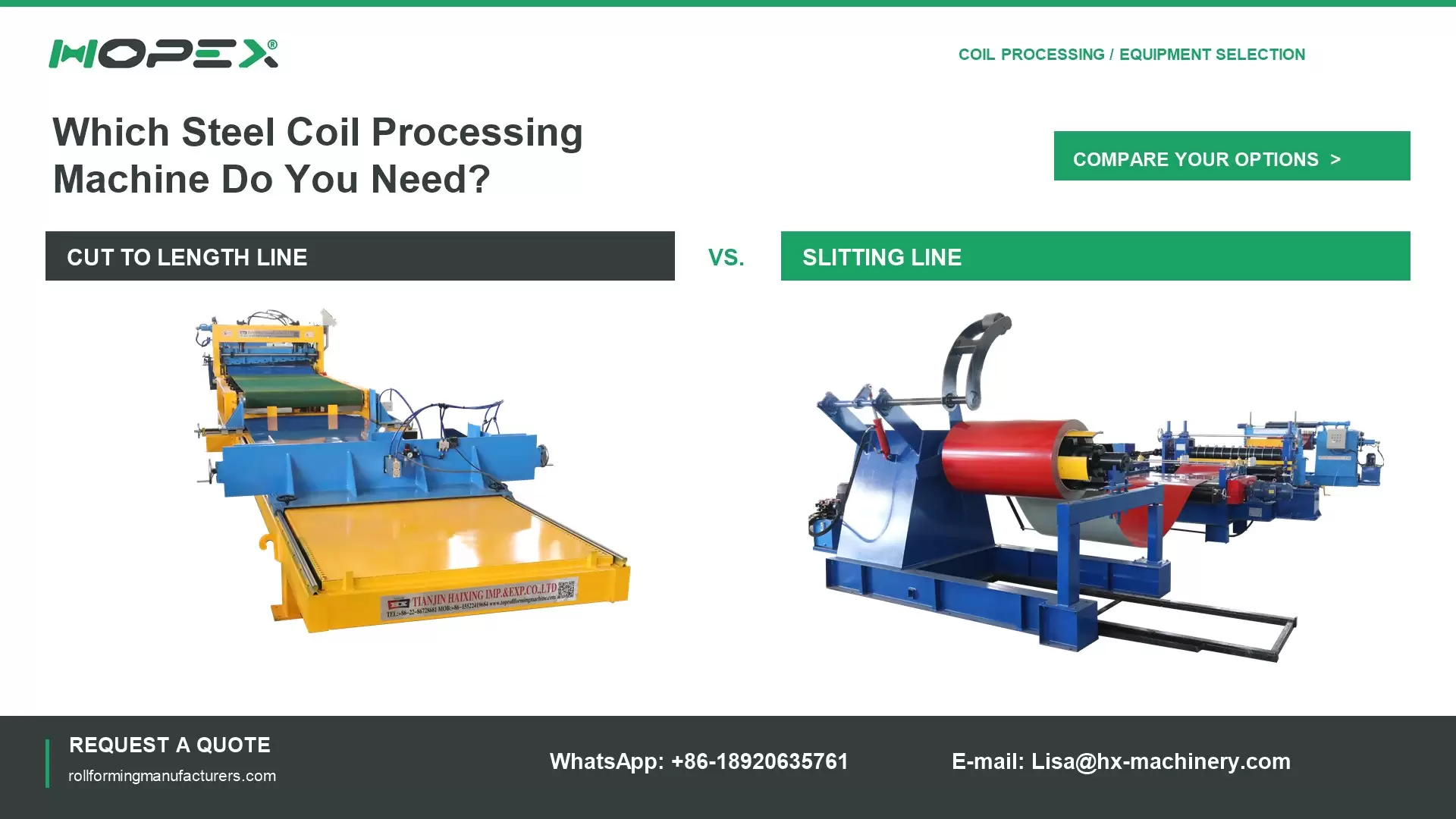
Steel coil processing is the upstream enabler for nearly every roll forming operation. Before a coil can be formed into a cable tray, guardrail, or rack upright, the raw coil material must be prepared — either cut to specific sheet lengths or slit into narrower strips for subsequent forming operations.
What Is a Cut to Length Line?
A cut-to-length machine line uncoils a steel coil, levels it to remove coil-set curvature, and cuts it into flat sheets of precise dimensions. The output is flat, level sheet stock ready for press stamping, laser cutting, manual plate fabrication, or distribution and resale as sheet metal.
Key machine components:
- Hydraulic uncoiler (5–30 ton capacity)
- Straightening/leveling section (7–23 rollers, depending on sheet thickness)
- Pinch roll feed with encoder length control
- Shear or guillotine cut-off
- Stacking/pallet unit
Tolerances: Modern CTL lines achieve length accuracy of ±0.5 mm and flatness standards of 5–10 mm per meter.
What Is a Steel Coil Slitting Line?
A slitting machine line cuts a wide steel coil longitudinally into multiple narrower strips — producing coils in the exact widths required for subsequent roll forming or stamping operations.
Typical applications:
- Producing slit coil in exact widths for roll forming lines (cable tray blanks, solar channel strip, guardrail strip)
- Preparing edge-trimmed strip for high-precision forming
- Creating multiple width variants from a single master coil to reduce inventory SKUs
Key machine components:
- Uncoiler (10–30 ton capacity, handles full master coil width up to 1,600 mm)
- Slitting head with circular knife sets (arbor-mounted disc knives with separators)
- Scrap chopper (edge trimming waste)
- Tension station (loop pit or bridle roll)
- Recoiler(s) — single-shaft or turnstile for multiple-slit operation
Tolerances: Slit width accuracy ±0.1–0.2 mm. Burr height standard: ≤0.1× material thickness.
Side-by-Side Comparison
When You Need Both
Many steel service centers and larger roll forming manufacturers operate both CTL and slitting lines, as they serve complementary functions:
- Master coils arrive from the steel mill in standard widths (typically 1,219 mm or 1,524 mm)
- The slitting line cuts these to precise widths for each forming application
- The CTL line cuts excess slit coil or unformed strip into sheet for distribution or direct sale
For roll forming operations with multiple lines requiring different strip widths, an in-house slitting line can reduce material cost by 8–15% versus ordering pre-slit coil from a service center.
Integration with Roll Forming Operations
For manufacturers operating cable tray roll forming machines, solar strut channel lines, or rack upright production lines, adding an in-house slitting line typically becomes economically justified when:
- Monthly consumption exceeds 300–500 tons of strip material
- You require 3 or more different strip widths
- Your forming lines run at high speed and slit coil availability is a production bottleneck
- Pre-slit coil from service centers carries significant width tolerance issues affecting your forming quality
The capital payback on a slitting line in this scenario is typically 12–24 months.
HOPEX Coil Processing Equipment
HOPEX designs and manufactures both cut-to-length machine lines and steel coil slitting machine lines, sized to complement our roll forming production line portfolio. Our coil processing equipment is engineered to work seamlessly as an upstream supply solution for our cable tray, solar channel, rack, and guardrail forming lines. Contact us now!
