



Stone-coated metal roofing is one of the fastest-growing segments in the global roofing market. Combining the durability of steel with the aesthetic appeal of traditional tile, slate, or wood shake profiles, stone-coated roofing commands premium pricing in residential and commercial construction markets across Africa, Southeast Asia, Latin America, and the Middle East.
What Is Stone Coated Metal Roofing?
Stone coated metal roofing consists of a steel substrate (typically Alu-Zinc coated, also known as Zincalume or Galvalume) coated with a bonding layer and then embedded with natural stone chips (basalt aggregate). The result is a roofing product that:
- Looks like clay tile, concrete tile, or wood shake
- Weighs 1.5–2 kg/m² (vs. 40–50 kg/m² for clay tile)
- Has a design life of 50+ years
- Provides excellent resistance to wind, hail, fire, and corrosion
- Reduces installation time and structural requirements compared to traditional tile
The Production Process
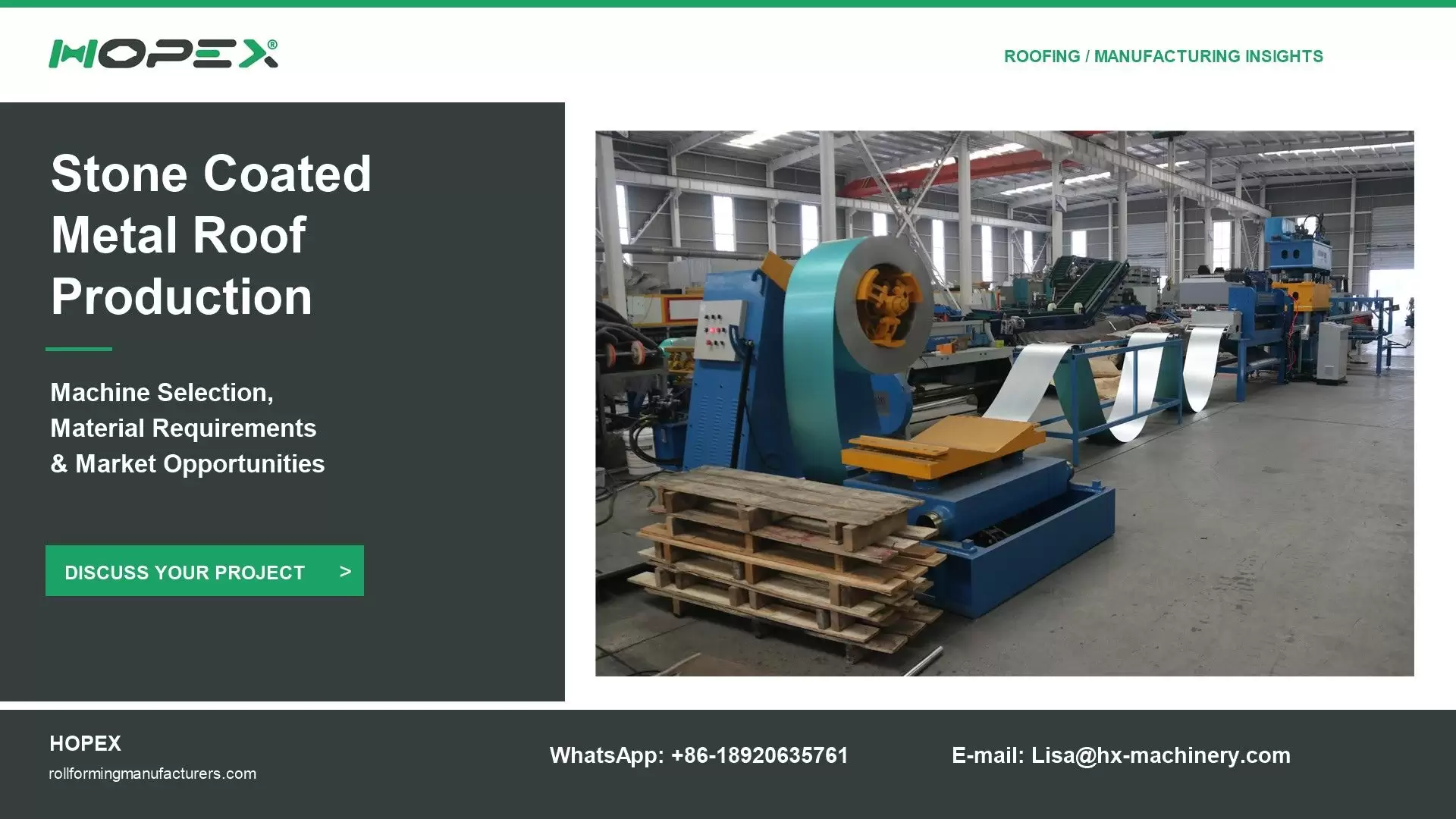
A complete production line includes:
1. Coil Feeding and Pre-Treatment Steel coils (Alu-Zinc, 0.4–0.5 mm thickness typically) are fed through cleaning and pre-treatment to ensure surface adhesion.
2. Acrylic Base Coat Application An acrylic adhesive layer applied to both surfaces bonds the stone aggregate to the steel substrate and provides initial corrosion protection.
3. Stone Chip Embedding Station Basalt or granite stone chips (3–5 mm, color-treated) are dispensed onto the adhesive-coated surface under controlled pressure.
4. Curing Oven Temperature range: 180–220°C. Cross-links the acrylic adhesive and permanently bonds stone chips to the substrate.
5. Roll Forming Section After curing, the stone-coated strip is formed into the final roof panel profile. Critical note: requires special roller surface treatment (polyurethane or rubber-coated rollers) to prevent damaging the surface coating.
6. Hydraulic Cut-Off and Stacking Panel length is typically 1,200–1,350 mm for tile profiles, matching standard installation module dimensions.
Material Specifications
Steel substrate:
- Base material: Galvalume (55% Al-Zn alloy coating, AZ150) or hot-dip galvanized (Z275)
- Thickness: 0.4–0.5 mm (residential); 0.5–0.6 mm (commercial/heavy duty)
- Tensile strength: 300–550 MPa
Stone aggregate:
- Material: Basalt (most common), granite, quartz
- Chip size: 2–5 mm, pre-treated with UV-resistant color coating
- Color options: Black, Brown, Red, Green, Gold, and custom blends
Market Analysis: Where Is This Product Selling?
Sub-Saharan Africa: The largest and most established market. Stone-coated roofing accounts for 15–25% of new residential roofing in Nigeria, Kenya, Tanzania, Ghana, and South Africa.
Southeast Asia (Indonesia, Philippines, Vietnam): Rapid urbanization driving roofing demand. Metal roofing preferred over concrete tile due to lightweight advantage on wood-frame structures.
Latin America (Mexico, Colombia, Peru, Chile): Mix of tile-look and wood-shake profiles. Alu-Zinc substrate preferred for corrosion resistance in coastal and tropical regions.
Middle East (Saudi Arabia, UAE, Jordan): Premium construction market. Flat tile and Roman tile profiles popular for high-end villa projects.
Investment and Production Economics
Why Partner with HOPEX for Stone Coated Roof Lines
HOPEX designs and manufactures complete stone-coated metal roof production lines, with experience in multiple tile profiles and surface coating systems. Our color stone roof sheet production line is engineered for consistent stone distribution and adhesion, multiple profile tooling with quick-change capability, and PLC-controlled curing temperature management.
Learn about HOPEX's engineering capabilities and our global customer base, or contact us for a production line specification tailored to your target market.
