



When a product designer or a manufacturing engineer specifies a new metal profile, three primary methods are on the table: roll forming, press braking, and stamping. Each has a fundamentally different cost structure, volume threshold, and capability profile. Choosing the wrong method for your volume and profile complexity is one of the most expensive manufacturing decisions you can make.
This article gives you an objective framework for making the right choice.
Method Overview
Roll Forming
A continuous process: flat metal strip is fed through a series of roll stations, each adding an incremental bend, until the final profile geometry is achieved. The process runs at 5–50 m/min and is highly suited to long runs of constant cross-section profiles.
Key characteristics:
- Very low cost per unit at volume (high throughput, low direct labor)
- High tooling cost ($30,000–120,000 per profile set)
- Long tooling lead time (4–10 weeks)
- Limited to profiles that can be formed progressively — cannot form internal void geometry
- Dimensional consistency very high over long runs
Press Braking
A discrete process: flat blanks are placed in a press brake and bent to a specific angle at each stroke. Multiple strokes per part are required for complex profiles.
Key characteristics:
- Very low tooling cost (standard tooling typically $2,000–8,000)
- Very fast tooling lead time (days, not weeks)
- High direct labor cost per unit (operator-intensive)
- Can handle very small quantities economically
- Profile complexity limited by the number of strokes and the nesting constraints of the die set
Stamping
A high-speed discrete process: a flat blank is formed in a progressive die that performs multiple operations (cutting, punching, forming, and bending) in a single stroke or a series of strokes in a progressive die.
Key characteristics:
- Extremely high tooling cost ($50,000–500,000 per progressive die set)
- Very long tooling lead time (8–16 weeks)
- Extremely low cost per unit at high volume
- Suitable for 2D formed parts; not for long linear profiles
- Dimensional consistency extremely high
The Volume Threshold Analysis
The fundamental decision between these methods is driven by volume and profile geometry:
The crossover from press braking to roll forming typically occurs where the tooling amortization cost of the roll forming line is offset by the labor cost savings from continuous automated production. In practice, this occurs at approximately 12–18 months of operating time for most industrial profiles.
Profile Geometry Constraints
Not every profile can be made by every method. The decision is sometimes made by geometry before volume considerations:
Roll forming advantages:
- Very long profiles (2 m – unlimited length) without tooling limitation
- Consistent cross-section along the entire length
- High production speed for simple-to-moderate complexity profiles
Roll forming limitations:
- Cannot produce profiles that vary in cross-section along their length (tapered sections require separate operations)
- Cannot produce fully closed profiles in a single pass (though some near-closed sections are achievable)
- Cannot easily produce features requiring forming in the Z-direction (through the material thickness)
Press braking advantages:
- Can handle wide plates (up to 6 m wide on large machines)
- Can produce non-prismatic shapes (by combining different tooling stages)
- Very fast tooling changeover for prototype or small-batch work
Stamping advantages:
- Can produce complex 3D formed geometries in a single stroke
- Very high dimensional repeatability for precision components
- Integrated punching, trimming, and forming in one operation
Where Roll Forming Dominates
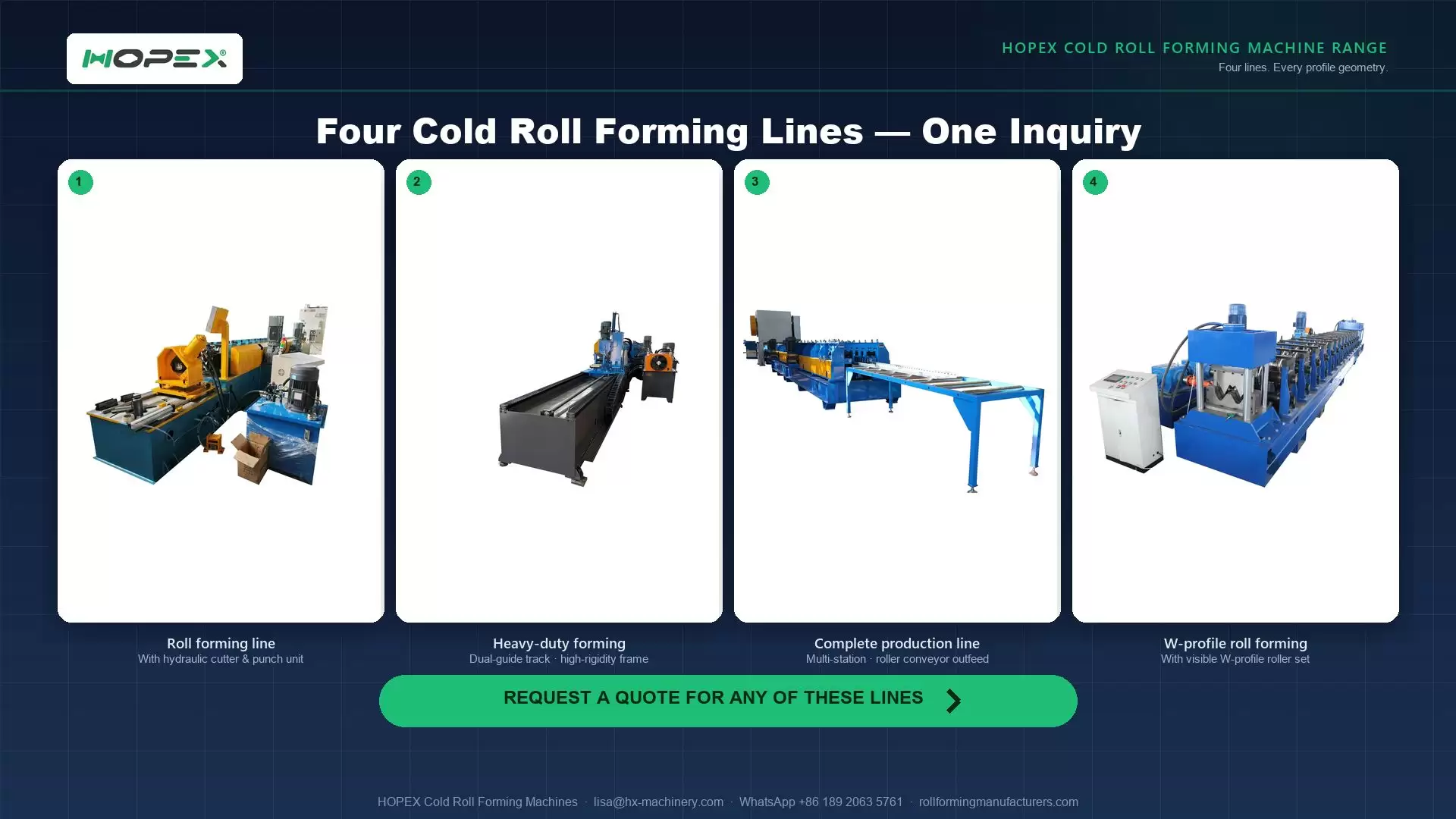
For the products HOPEX manufactures — cable trays, solar mounting channels, racking uprights and beams, highway guardrails — roll forming is unambiguously the right process. Each of these products shares the key characteristics that make roll forming the optimal method:
- Linear, constant cross-section profiles
- Annual production volumes in the thousands of meters to millions of meters
- Material gauges in the 0.8–4.0 mm range, well suited to cold roll forming
- Dimensional consistency requirements met by hardened, CNC-machined roll tooling
For these products, no alternative manufacturing method approaches the cost efficiency of roll forming at production volume. The capital investment in a roll forming line is a one-time cost that delivers competitive economics for 15–20 years.
Making the Decision for a New Profile
Use this decision framework:
- What is the annual volume? Under 500 m — press braking. Over 5,000 m — roll forming. Between: calculate break-even.
- Is the cross-section constant along the length? Yes — roll forming is viable. No — press braking or stamping required.
- Is the profile a long linear section or a short formed part? Long section — roll forming. Short part — stamping if volume justifies tooling cost.
- What is the tooling budget? Under $10,000 — press braking only. Over $50,000 available — roll forming is viable if volume justifies.
For the products on our HOPEX product range, roll forming is the correct answer to all four questions. If you are evaluating manufacturing method for a new profile, our engineering team can give you a quick assessment — contact us with your profile drawing and target volume.
