



Specifying the wrong cable tray type is one of the most common and costly errors in industrial electrical installation projects. It rarely causes an immediate visible problem — but over time it leads to cable degradation, failed inspections, or the need to rip out and replace an entire cable management system.
This guide gives electrical engineers, project managers, and cable tray manufacturers a clear framework for matching tray type to application requirements.
The Three Primary Cable Tray Types
Ladder Cable Tray
The most common type globally. Consists of two longitudinal side rails connected by transverse rungs, creating an open ladder-like structure. The open design provides:
- Maximum ventilation — critical for power cables that generate significant heat
- Easy cable routing and future additions without disrupting installed cables
- High load capacity with low self-weight (the rung structure is structurally efficient)
Best applications: High-voltage power distribution, data center infrastructure, industrial plants where heat dissipation is critical.
Limitations: No protection against dust, liquids, or mechanical impact to cables.
Perforated (Trough) Cable Tray
A solid-bottom tray with perforations in the base and/or sides. The perforations provide:
- Partial ventilation — better than solid bottom, less than ladder
- Mechanical protection from below against accidental contact or debris
- A solid surface that supports smaller-diameter cables without risk of deflection between rungs
Best applications: General electrical wiring in commercial buildings, mixed cable types (power + signal), areas with moderate dust or liquid splash risk.
Limitations: Heavier than ladder; perforation pattern reduces structural efficiency compared to solid bottom.
Solid Bottom Cable Tray
A continuous solid-bottom trough with no perforations. Provides:
- Maximum protection against dust, moisture, and physical damage
- Required for certain instrument and signal cable installations where electromagnetic shielding matters
- Essential in hazardous area classifications where cable protection standards mandate fully enclosed routing
Best applications: Chemical plants, offshore platforms, food processing, pharmaceutical facilities, sensitive instrumentation.
Limitations: Heavier, more expensive, poor heat dissipation — do not use for high-current power cables without thermal derating calculations.
Application Decision Matrix
Material Selection: Galvanized Steel, Stainless, or Aluminum?
Beyond the tray type, material specification determines lifecycle performance:
Hot-Dip Galvanized Steel (HDG) The standard for most industrial and commercial applications. Provides 20–25 years of corrosion protection in typical indoor industrial environments. Cost-effective and widely specified.
Pre-Galvanized / Electro-Galvanized Steel Lower coating weight — suitable for dry indoor environments only. Not for outdoor or high-humidity applications.
Stainless Steel (304 or 316) Required for food processing, pharmaceutical, and coastal/offshore environments. 316 grade necessary where chloride exposure is expected. Significantly higher cost, justified by lifecycle economics in corrosive environments.
Aluminum Lightweight alternative for applications where structural weight is critical (raised floor data centers, weight-sensitive facilities). Not suitable for high-temperature environments or where galvanic corrosion with dissimilar metals is a risk.
How Cable Tray Machines Are Configured for Each Type
The tray type choice directly determines the roll forming machine configuration needed to manufacture it:
- Ladder tray: Requires two separate roll forming lines (one for the side rail, one for the rungs) plus a welding or mechanical assembly station.
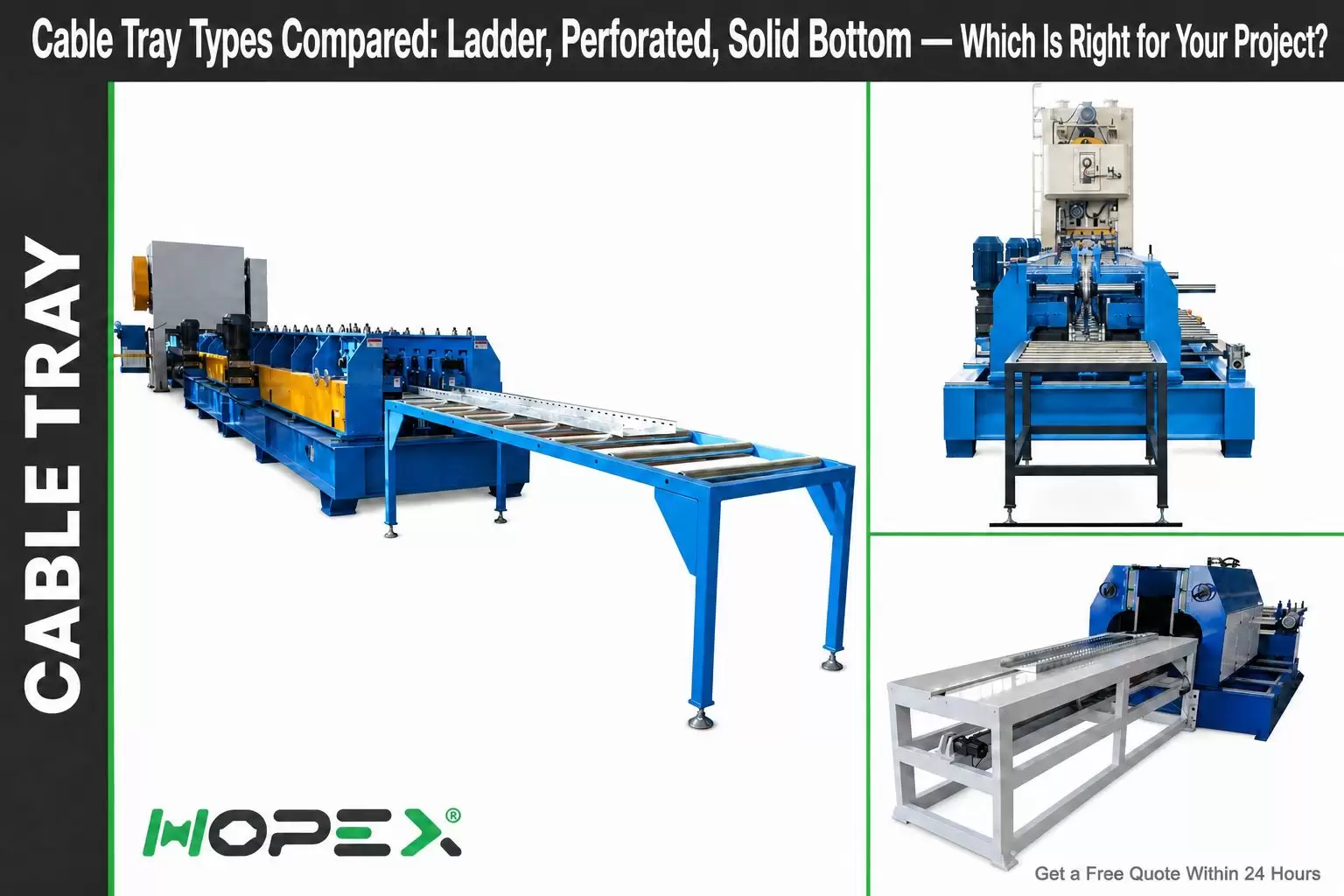
- Perforated tray: A single integrated line with an in-line punching station for the perforation pattern. Our Cable Tray Manufacturing Machine range covers this configuration.
- Solid bottom tray: Simpler roll forming — no punching required for the base, though a separate line is needed for the cover if fitted.
For manufacturers considering which product type to focus on, we recommend reading our detailed article on Cable Tray Roll Forming Machine production processes, which covers the full production line architecture.
Key Takeaway for Cable Tray Manufacturers
If you are manufacturing cable trays for sale, the commercial imperative is to offer at least perforated (trough) and solid-bottom variants — these two types together cover the majority of the commercial and industrial market. Ladder tray requires a more complex line investment but opens the high-specification industrial and data center markets.
For equipment specifications and availability, visit the HOPEX Cable Tray Machine product page or contact our team for a consultation on the right line configuration for your target product range.
