



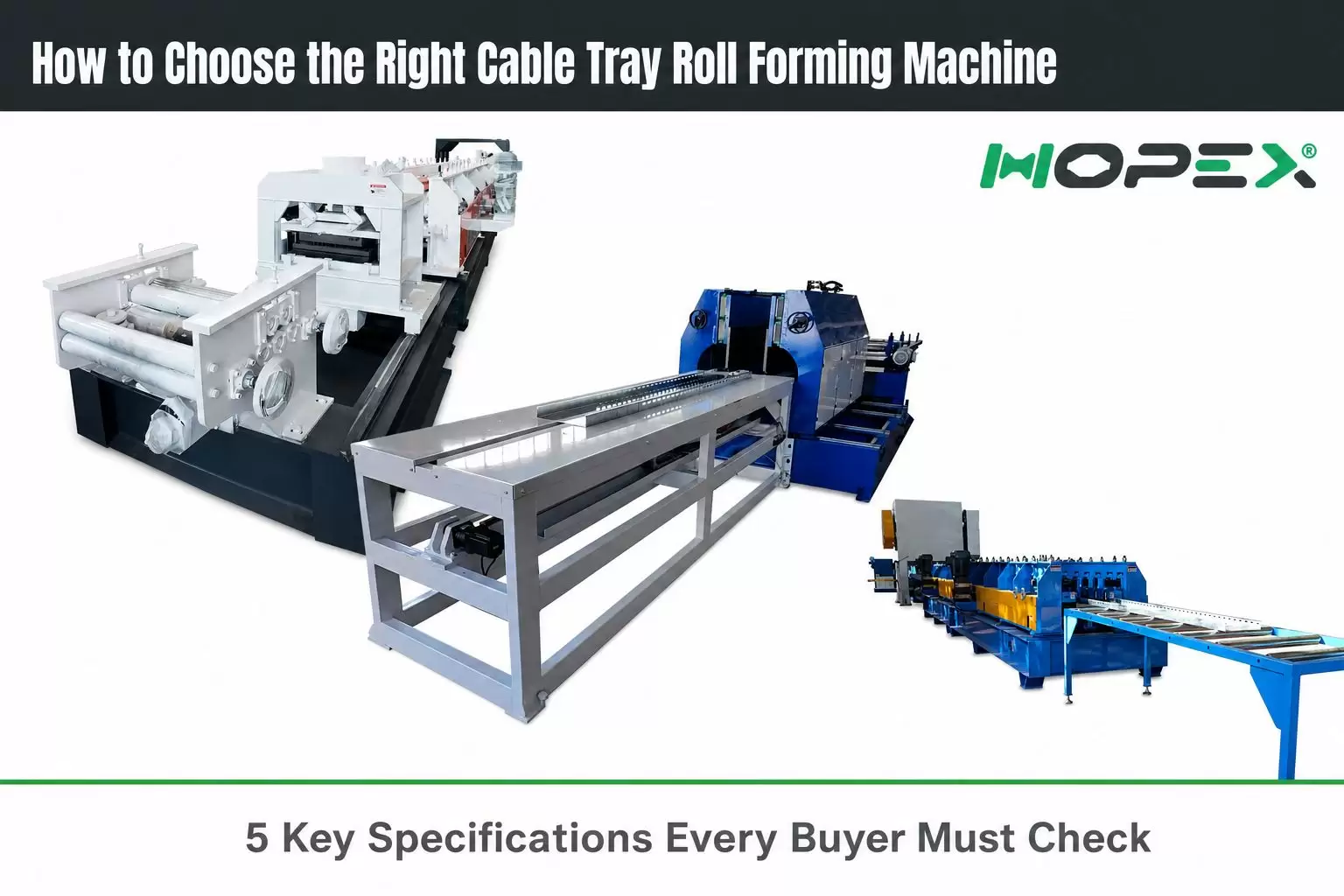
Buying a cable tray roll forming machine is not a catalogue decision — it is a capital investment that will define your production capacity, your product range, and your cost-per-meter for the next 10 to 15 years. Yet most buyers compare machines on price alone and only discover the real differences after the equipment arrives.
This guide covers the five specifications that actually matter, with real numbers from the field.
1. Material Thickness Range (And Why Your Machine Must Handle Both Ends)
The single most overlooked specification is the full thickness range: the minimum and maximum gauge the machine can form without compromising dimensional accuracy.
Standard cable tray production requires processing material between 0.8 mm and 2.5 mm. The bottom end matters for lightweight ventilated trays; the top end matters for heavy-duty trench trays. A machine rated "up to 2.0 mm" will produce acceptable parts in the middle of that range but struggle or drift on 2.5 mm material — you will see flare, springback, and hole distortion.
What to check before you buy:
- Ask the supplier to run a sample in 2.5 mm galvanized at your target speed. If they hesitate, that is your answer.
- Verify the punch die clearance is adjusted for thick material. Clearance that works for 0.8 mm creates burrs on 2.5 mm.
See our Cable Tray Manufacturing Machine range — each model specifies the full tested thickness range.
2. Production Speed — Rated vs. Actual
Machine specifications list rated speed, often 8–15 m/min. Actual throughput depends on:
- Punch density: a tray with holes every 50 mm punches 3× more often than one with holes every 150 mm, which directly caps production speed.
- Cut-to-length cycle: hydraulic shear systems add 1–3 seconds per cut; servo flying-cut systems eliminate this dead time.
- Operator skill and material loading efficiency: even the fastest line runs at 60% rated speed if material loading is manual.
Realistic expectation: For a standard 600 mm × 100 mm perforated cable tray, plan for 6–9 effective meters per minute in single-shift operation, not the headline 12 m/min.
3. Roll Material and Hardness — The Maintenance Trap
This is where the long-term cost hides. Cheap machines use 45# steel rollers with surface hardening, which sounds reasonable until you run 2.0 mm galvanized-coated steel for six months and watch the rollers wear to the point where your tray sidewalls start creeping out of tolerance.
Industry benchmark: Cr12MoV die steel, precision CNC-turned, hardened to HRC 58–62. This combination extends roller life 4–6× compared to basic 45# steel and is the standard we apply across all HOPEX cable tray lines.
Ask the supplier for the steel grade certificate and hardness test report. If they cannot provide both, walk away.
4. PLC Control System — Who Wrote the Software?
Almost every modern roll forming machine uses a PLC controller. The brand matters less than the software logic built on top of it. Key questions:
- Can operators enter a new product specification (width, height, hole pitch, length) directly on the touchscreen, or does it require an engineer to edit parameters?
- Does the machine store multiple product recipes, or does the operator re-enter values every shift?
- What happens when the system errors? Is there a diagnostic display or just an alarm buzzer?
A machine with a solid Mitsubishi or Siemens PLC running poorly written software will frustrate operators just as much as a cheap controller. Request a live demo of recipe changeover before purchase.
5. After-Sales Support — The Real Differentiator
For overseas buyers, the machine arrives, gets installed, and then — inevitably — something needs adjustment. The quality of the supplier's after-sales response is more important than any specification on the data sheet.
Minimum requirements:
- Remote support capability (video call, PLC remote login)
- Spare parts available ex-stock for wear components (punch dies, rollers, shear blades)
- Ability to dispatch a service engineer within 30 days if needed
We cover this in detail in our article on Cable Tray Production Line capabilities, which also explains the full production process so you know exactly what to expect when your line arrives.
Before You Shortlist Suppliers
Start with your own production brief:
| Question | Your Answer |
| Target cable tray width range? | e.g. 200–600 mm |
| Material: galvanized steel / stainless / aluminum? | ... |
| Required thickness range? | ... |
| Target daily output (meters or pieces)? | ... |
| Shift structure (1 or 2 shifts)? | ... |
With those five answers, a qualified supplier can specify the right machine in under 24 hours. Without them, you are comparing specifications that do not match your actual needs.
Ready to compare options? Contact HOPEX with your production brief and we will respond within 24 hours.
