



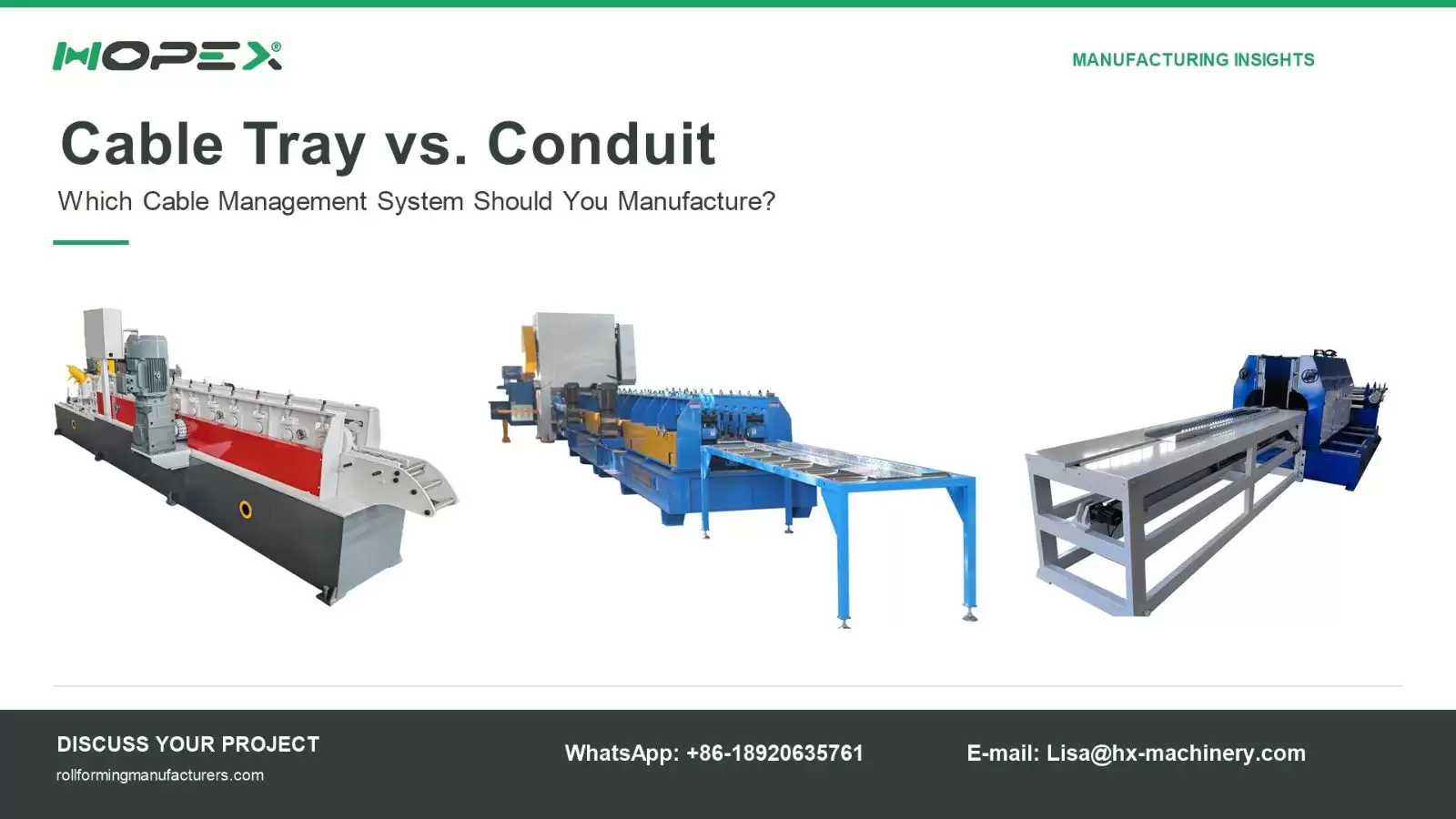
If you're entering the cable management manufacturing market — or expanding an existing product line — the first strategic question is which system to produce: cable trays or conduit. Both protect electrical cables and data infrastructure, but they serve different environments, installation requirements, and market segments.
This article gives you the data you need to make that decision from a manufacturing and market perspective.
Defining the Two Systems
Cable trays are open or semi-enclosed support systems — ladder trays, ventilated troughs, or solid-bottom trays — that route cables in industrial, commercial, and data center environments. They are produced by cable tray roll forming machines and offer high accessibility, easy cable additions, and excellent heat dissipation.
Electrical conduit is an enclosed tube (rigid or flexible) through which cables are threaded. It offers superior physical protection and is required by code in many residential and light commercial applications. Conduit is produced by pipe mills or tube forming machines — a different manufacturing process entirely.
Market Size and Growth Comparison
The global cable tray market was valued at approximately $3.5 billion in 2024 and is forecast to grow at 7.2% CAGR through 2030, driven by:
- Industrial infrastructure expansion in developing markets (India, Southeast Asia, MENA)
- Data center construction boom (cloud and AI infrastructure)
- Renewable energy project growth requiring cable management at solar and wind sites
The global electrical conduit market is larger ($17 billion+) but more commoditized, with lower margins and intense price competition from existing manufacturers.
For a new market entrant, cable trays offer a better margin opportunity with lower production complexity and higher product differentiation potential.
Manufacturing Comparison
A cable tray production line based on a professional cable tray manufacturing machine can be operational within 60–90 days of delivery, with a trained operator team producing saleable product from day one.
Application Environments: Where Each System Wins
Cable trays are preferred in:
- Oil and gas refineries and petrochemical plants — where massive cable volumes need organized routing and maintenance access
- Data centers — open trays allow airflow management and easy cable additions/changes
- Industrial manufacturing plants — overhead tray systems are more cost-effective than conduit at large scale
- Renewable energy installations — solar farm cabling routed in cable trays from inverter to switchgear
Conduit is preferred in:
- Residential and light commercial construction — required by NEC and most building codes
- Underground buried runs — rigid conduit provides mechanical protection against ground movement
- Hazardous areas (ATEX zones) — sealed conduit prevents ignition of flammable atmospheres
- Exposed runs subject to physical damage
Material Options and Their Target Markets
Cable trays are produced from three primary materials, each serving a different market segment:
Hot-dip galvanized steel (HDG): The dominant material for industrial applications. Low cost, excellent mechanical strength, 20–40 year corrosion resistance in standard environments.
Stainless steel (304 or 316): Required for food processing, pharmaceutical, and marine/offshore applications. Premium pricing (3–5× HDG cost) with high margins.
Aluminum: Growing in data center applications where non-magnetic, lightweight properties are valued. Good corrosion resistance without coating.
A well-configured cable tray line can switch between materials with tooling adjustments, giving manufacturers access to all three market segments from a single production line.
The Manufacturing Verdict
For manufacturers entering the cable management market, cable tray production offers the more attractive opportunity in 2025–2030:
- Higher market growth rate
- Better margin potential through product differentiation
- Lower equipment investment
- Broader application base across industrial, commercial, and energy sectors
If you're already producing conduit and looking to expand your product range, adding a cable tray line creates a natural complement — you can offer turnkey cable management solutions to industrial clients.
Learn more about cable tray manufacturing machines from HOPEX, or contact our team for a production line proposal matched to your market.
Conclusion
Cable tray and conduit serve different market segments and production requirements. For new entrants seeking strong growth markets with good margin potential, cable tray manufacturing offers a clear advantage. The key is pairing the right production equipment with a clear market focus.
Explore HOPEX cable tray machine range — ladder tray, ventilated trough, and solid bottom configurations available. Learn about us and our 21+ years of roll forming experience.
