



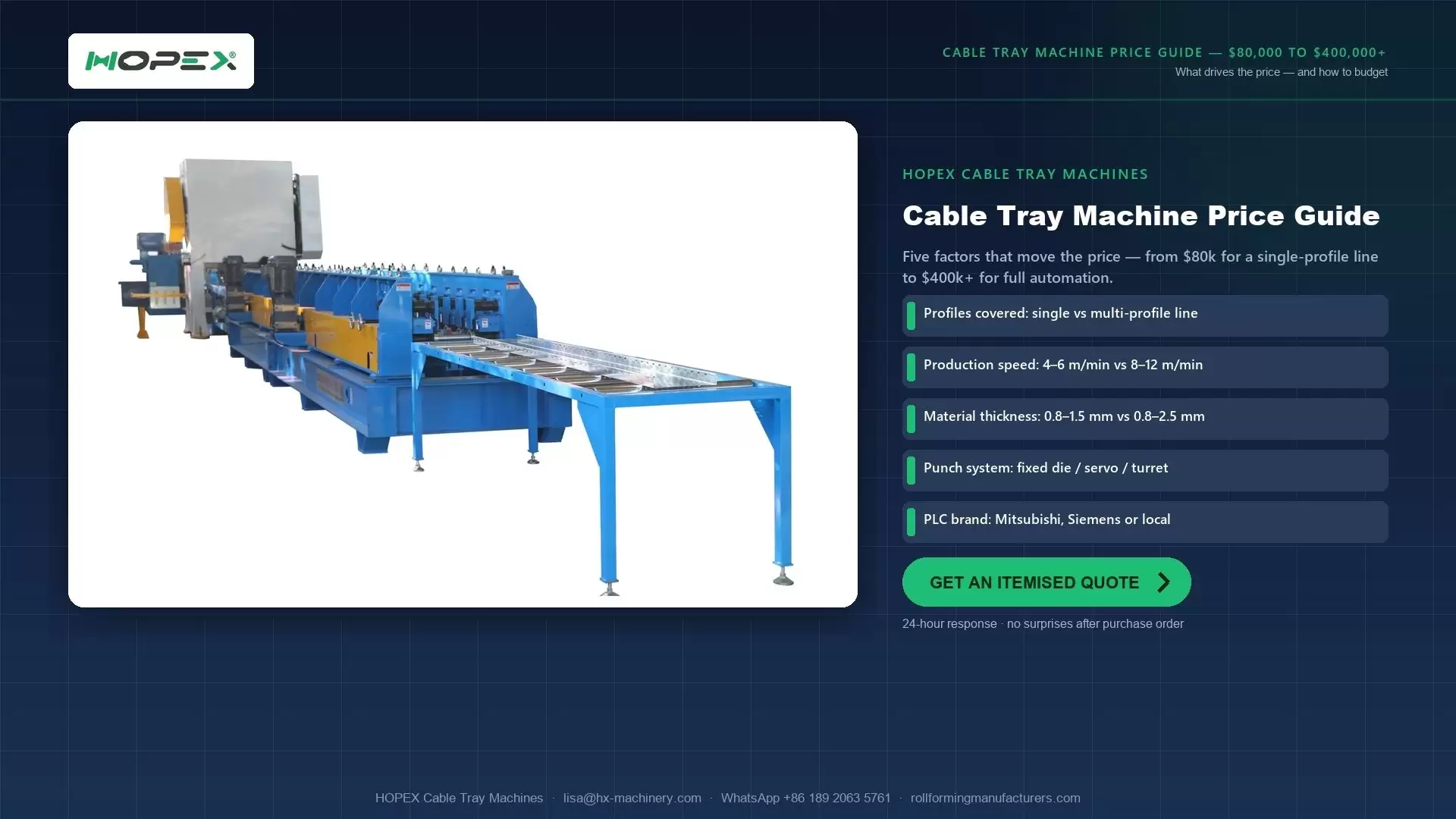
One of the most common questions we receive from first-time cable tray machine buyers is: "How much does it cost?" It is a reasonable question, and the honest answer is: it depends — significantly — on factors that most buyers do not know to ask about. This guide explains what drives cable tray machine pricing and how to build a realistic budget.
The Price Range (And Why It Spans $80,000 to $400,000+)
A cable tray roll forming machine can range from under $100,000 for a basic single-profile line to over $400,000 for a fully automated multi-profile production system. This is not primarily a quality difference — it reflects genuine differences in capability and scope.
The main factors:
Factor 1: Number of Profiles Covered
A dedicated single-profile line (one tray width, one tray height, one punching pattern) is the simplest and lowest-cost configuration. A multi-profile line with automatic width adjustment and interchangeable punch dies costs significantly more but eliminates tooling change time and enables rapid response to varied customer orders.
Budget implication: If you need to produce 3+ different tray sizes, the cost of multiple single-profile lines quickly exceeds the cost of a properly specified multi-profile line. Do the math for your specific product range before choosing.
Factor 2: Production Speed and Automation Level
A basic line with a manual decoiler, hydraulic stop-and-cut system, and manual stacking operates at 4–6 effective meters per minute with 2–3 operators. An automated line with a powered decoiler, flying shear, and automatic stacking runs at 8–12 effective meters per minute with 1 operator.
The capital cost difference between these configurations might be $60,000–100,000. Whether that premium is justified depends on your target throughput and labor cost structure.
Rule of thumb: If local labor cost is high (above $25/hour loaded), automation pays back within 2–3 years at moderate production volumes. If labor is low-cost, basic lines are often more economical.
Factor 3: Material Thickness Capability
A machine rated for 0.8–1.5 mm material uses lighter frames, smaller drives, and lower-specification punch tooling than a machine rated for 0.8–2.5 mm. The thicker-gauge machine costs 20–35% more to build — and is worth every dollar if you need the capability.
Do not buy a light-gauge machine and discover after delivery that your primary customer's specification requires 2.0 mm material.
Factor 4: Punch System Type
The punching system is often the highest-cost component of a cable tray line. Options in ascending cost order:
- Fixed punch die: one pattern, no flexibility, lowest cost
- Servo-driven programmable punch: configurable hole spacing from the PLC, moderate premium
- Servo multi-tool punch turret: multiple hole shapes and patterns, highest cost — necessary for complex perforation patterns
If you are producing standard IEC-pattern cable trays for a single market, a fixed punch die may be entirely adequate. If you need to produce product for multiple national standards with different hole patterns, programmable punching is essential.
Factor 5: PLC and Control System
The same physical machine with a Mitsubishi PLC and HMI costs more than with a basic local-brand controller — but offers better reliability, a larger global service network, and operators who are more likely to have prior familiarity with the interface.
For machines sold into developed markets (EU, US, Australia), specifying a Mitsubishi or Siemens PLC is almost always the right decision on total-cost-of-ownership grounds.
Building Your Budget: The True Total Cost
The machine price is only part of the total investment. Budget for:
Questions to Ask Before Finalizing Your Budget
- Is commissioning and installation included in the price or quoted separately?
- What spare parts are recommended for the first year, and are they included?
- Is freight quoted ex-works or CIF? (The difference can be $15,000–25,000 for Asia-to-Europe shipments)
- What is the total installation time, and do you need to plan for production downtime during installation?
For a detailed breakdown of what is included in each of our line configurations, visit the Cable Tray Manufacturing Machine product page or contact HOPEX with your production requirements. We provide itemized quotations that make the total cost transparent — no surprises after the purchase order is placed.
, a total investment budget framework, and questions to ask before finalizing your purchase decision.)