



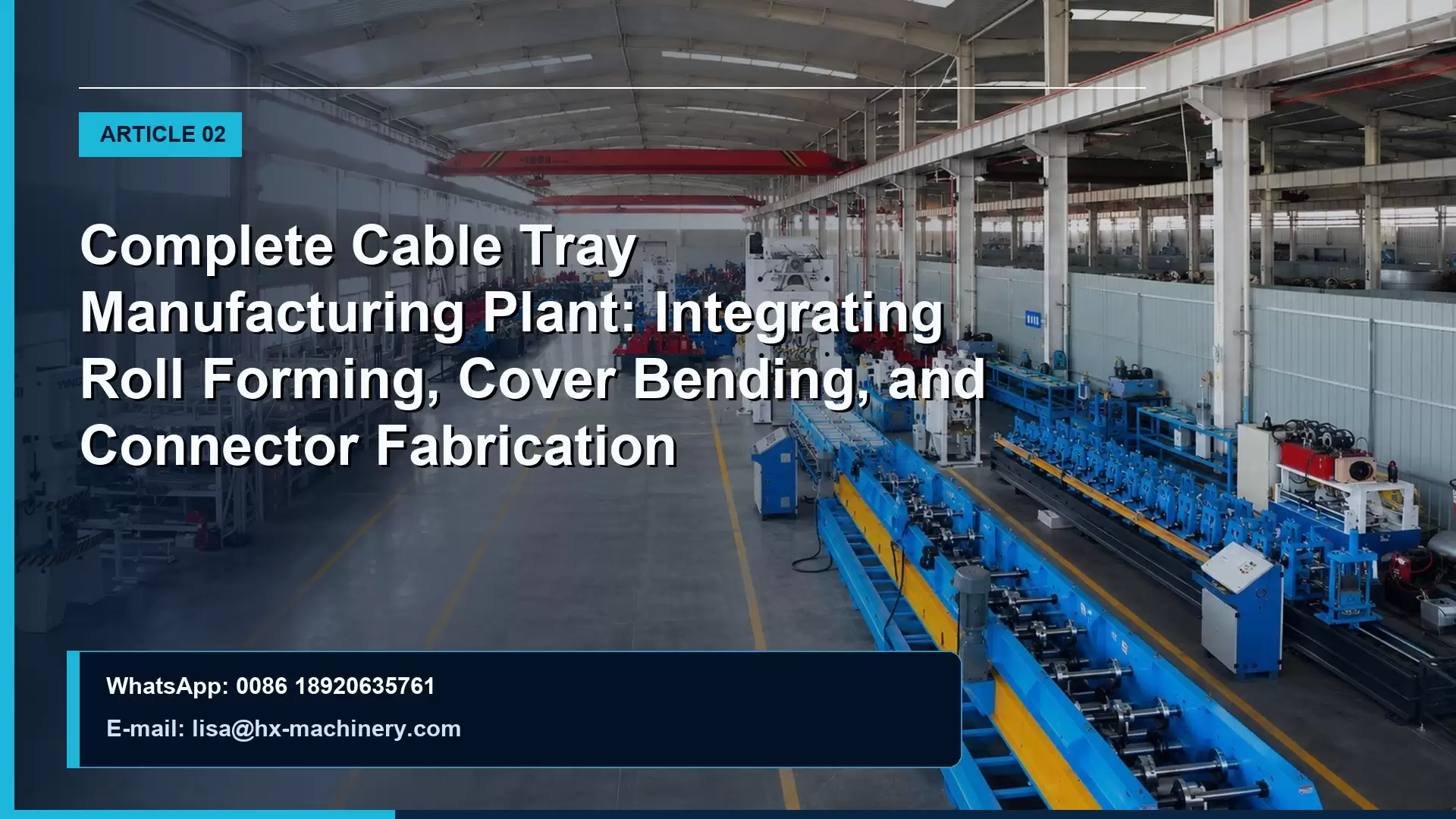
Establishing a profitable cable tray business requires more than just churning out straight tray profiles. In global infrastructure tenders—whether for gigawatt solar farms, metro rail networks, or hyperscale data centers—EPC contractors mandate complete turnkey systems. A vendor who supplies only the tray body while forcing clients to source tray covers, splice plates, and horizontal bends elsewhere will consistently lose bids to comprehensive system suppliers.
1. Straight Trays vs. Modular System Components
A complete electrical cable pathway installation consists of five mandatory components:
- Straight Cable Trays: The bulk linear footage (produced via roll forming).
- Snap-on / Flanged Covers: Protection against outdoor weathering, UV radiation, and falling debris.
- Splice Plates (Couplers): Precision-punched connecting plates that maintain grounding continuity and mechanical alignment.
- Fittings (Bends, Tees, Crosses, Reducers): Fabricated or formed directional transitions.
- Support Hardware: Cantilever brackets and trapeze hangers.
Supplying the straight tray captures only 55% of the total project billing value. Adding covers, couplers, and fittings captures the remaining 45%, where profit margins typically run 10% to 18% higher due to reduced commodity price transparency.
2. Dedicated Machinery for Cable Tray Covers
While standard straight trays have upright vertical side walls with outward or inward return lips, tray covers feature shallow down-turned flanges designed to snap tightly onto the tray side rails. Running tray covers on a heavy-duty straight-tray machine causes inefficient line utilization and premature wear on heavy shafts.
HOPEX manufactures dedicated cable tray cover roll forming machines designed specif ically for light-gauge (0.6 mm to 1.2 mm) sheet steel. These compact lines operate at rapid speeds of up to 25 m/min with quick-width manual or motorized adjustment, allowing operators to change cover widths from 100 mm to 600 mm in less than five minutes.
3. Bending Solutions for Custom Fittings and Transitions
Directional fittings—horizontal elbows (45° and 90°), vertical outside/inside risers, tees, and cross-junctions—require specialized forming. Because fittings involve complex geometries and lower individual batch sizes, roll forming is unfeasible. Instead, modern production shops deploy a dedicated cable tray bending machine paired with CNC hydraulic notchers.
The process workflow operates seamlessly:
- Flat galvanized sheet blanks are pre-notched using CNC turret presses or fiber lasers.
- The specialized tray bender forms the return flanges and bottom bends in a single handling, maintaining clean edge alignments that weld or rivet cleanly into standard fittings.
- Bolt holes on fitting flanges match the exact hole pattern produced on your roll formed trays, ensuring flawless site assembly.
4. Turnkey Factory Layout and Material Flow Optimization
When setting up an integrated plant, raw material coil storage must feed smoothly into both the primary cable tray making machine production line and the auxiliary blanking lines. Coils weighing between 5 and 10 tons should be handled via a motorized coil car and hydraulic decoiler to prevent crane bottlenecks.
To discover how HOPEX delivers complete cable management manufacturing packages—including straight tray lines, cover formers, bending equipment, and punching dies—visit our official homepage or check out our full equipment catalog. When you are ready to evaluate factory floor plans and equipment pricing, contact our engineering consultants for a comprehensive proposal.
