



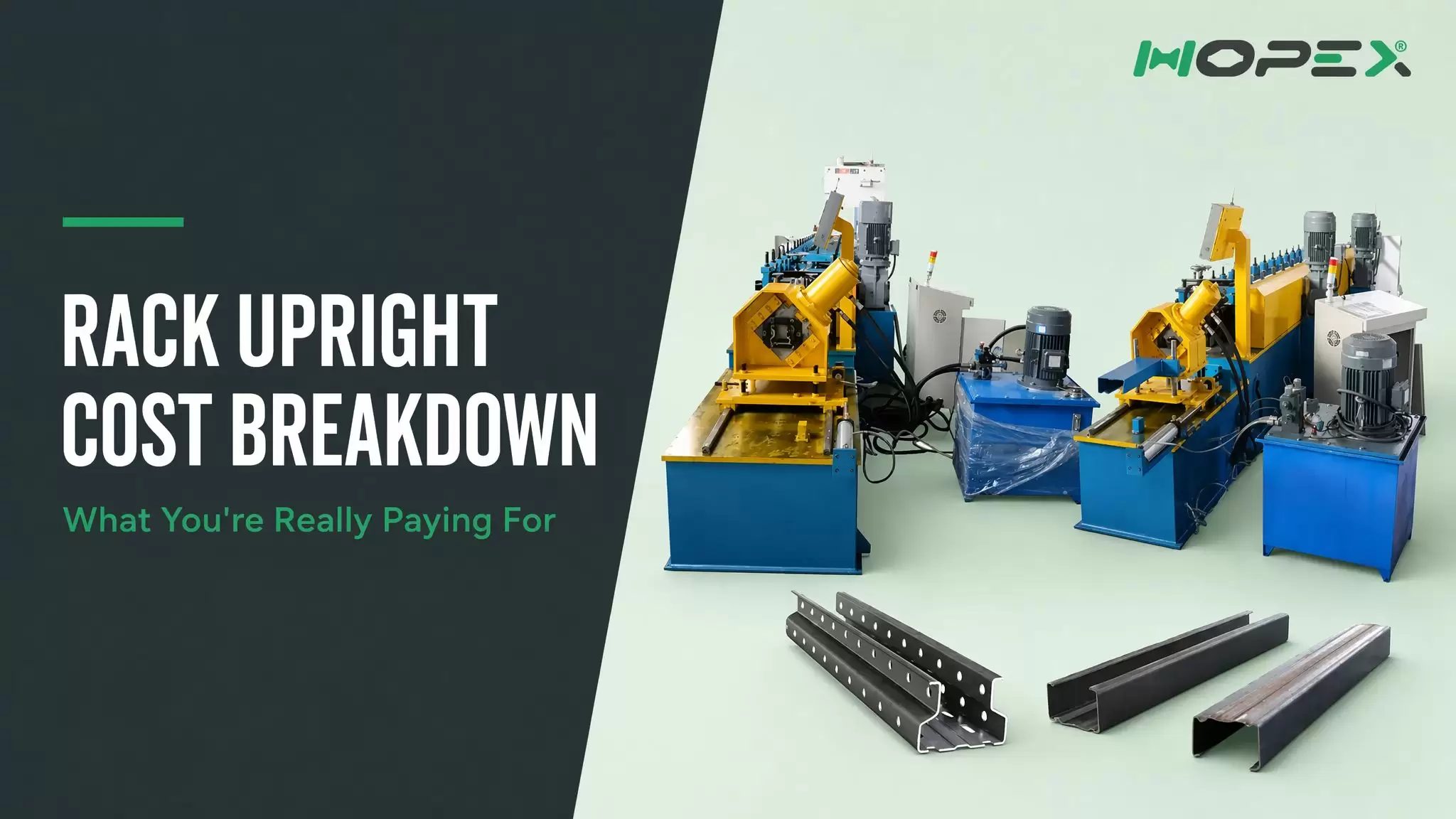
Rack Upright Cost Breakdown: What You're Really Paying For
When buyers compare upright prices from different suppliers, they're often not comparing the same product. A 10% price gap can reflect a 30% difference in steel consumption or a cut-corner surface finish. Here's what drives the cost of a roll-formed rack upright — so you can evaluate quotes properly.
The 4 Real Cost Drivers
1. Raw Steel Input Weight
The upright's cross-section and wall thickness directly determine how much steel goes into each meter of column. A 100×45×1.8mm upright uses roughly 2.1 kg/m of Q235 steel. Suppliers who quote the same dimensions at much lower prices are usually running thinner walls — 1.5mm instead of 1.8mm — which cuts material cost ~17% but reduces column load capacity significantly.
What to check: Ask for the actual measured thickness at the corner bends, not just the nominal spec. Springback and thinning at bends are where cheap tooling shows up.
2. Steel Grade
Upgrading from Q235 to Q345 adds roughly 8–12% to material cost but increases the safe working load of the same profile by 30–40%. For racks above 5 meters, the structural safety margin makes Q345 the right choice — not a premium upsell.
3. Roll Forming Line Quality
Uprights are produced by passing coil steel through a sequence of roll dies that progressively bend the flat strip into shape. Line quality affects:
- Dimensional consistency: Punch pitch variance >±0.5mm causes beam misalignment on site
- Straightness: Bow or twist in uprights leads to racking lean and load instability
- Hole quality: Clean punched holes vs. torn edges affect beam connector engagement
HOPEX runs servo-controlled CNC roll forming lines with in-line punching — the perforation pitch is held to ±0.3mm, which matters when you're assembling 1,000 bays.
4. Surface Treatment
| Finish | Cost Index | Best For |
| Powder coat (standard) | 1.0× | Indoor dry warehouses |
| Epoxy powder coat | 1.15× | Chemical resistance |
| Hot-dip galvanizing | 1.4–1.6× | Outdoor, cold storage, humid |
| Pre-galvanized coil | 1.2× | Balance of cost and corrosion resistance |
A hot-dip galvanized upright costs more upfront but eliminates re-coating maintenance for 15–25 years in harsh environments. Powder coat on a cold-room upright may need replacement within 5 years.
What a Realistic Price Looks Like
For a standard Q235B, powder-coated, 100×45×1.8mm upright produced in China:
- Ex-works price: USD 1.10–1.40/kg (2024–2025 reference, fluctuates with HRC steel prices)
- 20ft container load: ~18–22 MT of uprights depending on length
- Freight to major ports: USD 1,200–2,000/container (varies by destination)
Quotes below USD 0.90/kg for this spec should be cross-checked against actual thickness measurement upon arrival.
Summary: Don't Buy on Price Alone
The structural integrity of a racking system depends on every upright performing to spec — under dynamic load, over years of use. Verify: steel grade certificate, thickness measurement, and punch pitch tolerance before committing to a supplier.
Request HOPEX component spec sheets and mill certificates — we provide full material traceability on every order.
WhatsApp: 0086 18920635761
E-mail: lisa@hx-machinery.com
