



The dramatic fall in solar electricity costs over the past decade is typically attributed to declining PV panel prices and improving cell efficiency. Less discussed — but equally important — is the concurrent reduction in balance-of-system (BOS) costs, which includes the structural mounting hardware that supports every solar panel installed worldwide.
Roll forming technology has been a central driver of that cost reduction, and understanding how it works gives solar developers and mounting system suppliers a clearer picture of where margins are made and where they are lost.
The Cost of Mounting Structure in a Utility-Scale Project
In a typical utility-scale ground-mount solar project, the structural mounting system represents 8–15% of total project cost. On a 100 MW project, that translates to roughly $3–6 million in structural hardware. The key components:
- Ground screws or concrete ballast (foundation)
- Posts / piles (vertical supports)
- Horizontal purlins / rails (channel profiles)
- Module clamps and fasteners
- Wire management components
Of these, the horizontal purlins and rails are the highest-volume roll-formed component — typically representing 60–70% of the total steel weight in a ground-mount system.
How Roll Forming Reduces Channel Manufacturing Cost
The economic advantage of roll forming over alternative manufacturing methods (press braking, extrusion) becomes significant at the production volumes required for solar projects.
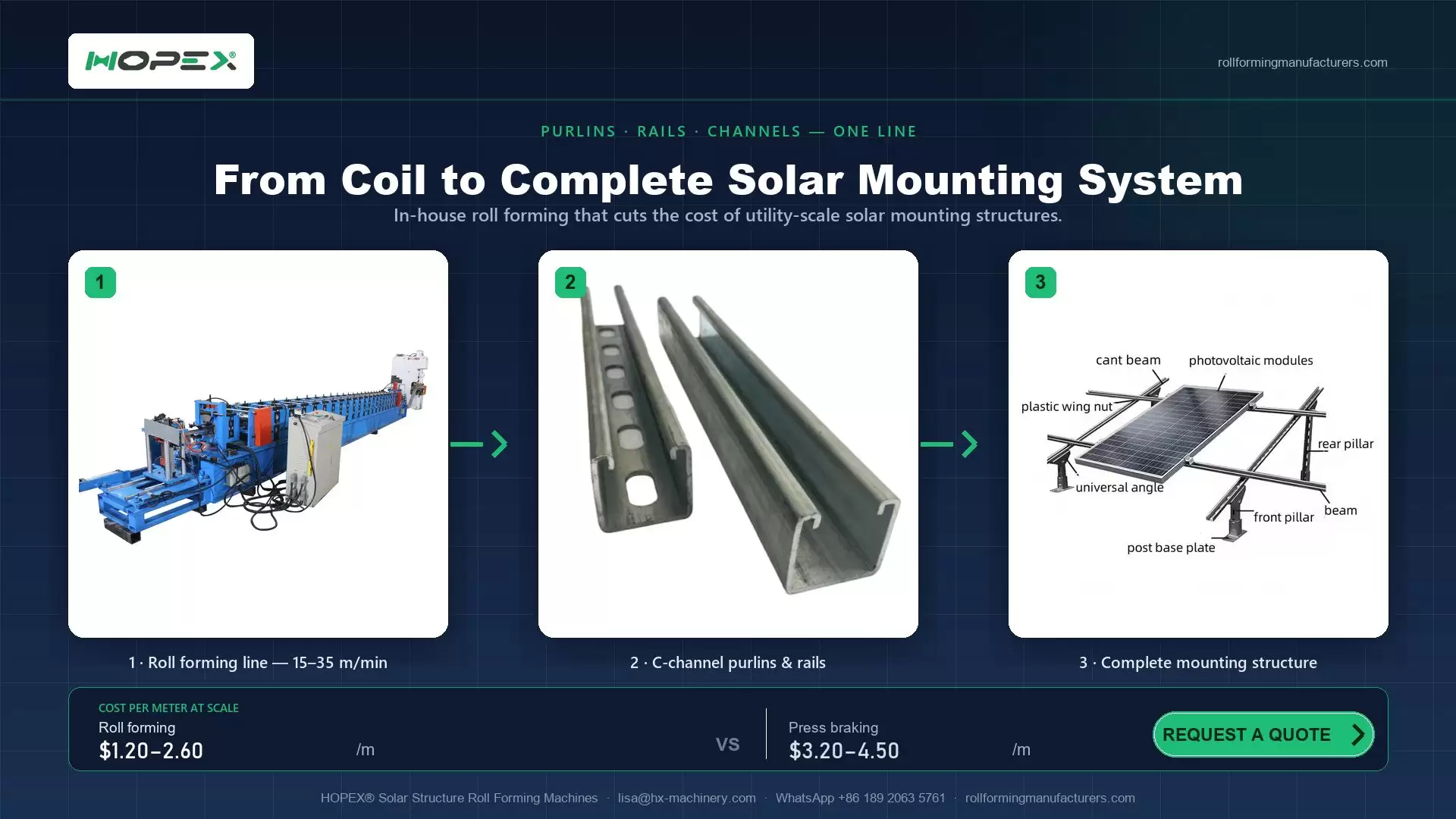
Press braking can produce the same C-channel profiles but requires separate tooling setup for each profile variant, dies that cost $2,000–8,000 per profile set, and operator attention at every forming step. At 100 m of channel per day, press braking is cost-competitive. At 5,000 m per day, it is not.
Roll forming amortizes tooling cost over vastly greater volumes, runs with minimal operator intervention, and achieves production speeds of 15–35 m/min — producing 7,000–16,000 meters of channel per operating shift.
The cost difference per meter becomes significant at project scale:
Profile Design Innovations That Only Roll Forming Can Deliver
Modern solar mounting channel designs have evolved specifically to exploit roll forming's capabilities:
Tri-chord rail profiles: a profile with three load-bearing flanges rather than a simple C-section. This configuration achieves 30–40% higher bending stiffness with the same material weight by distributing the cross-section more efficiently. A press brake cannot form this in a single pass; a roll forming line with 14–18 stations does it in continuous operation.
Integrated wiring channels: some current rail designs incorporate a small channel within the main profile for cable routing, eliminating separate cable management components. Only roll forming can produce this compound profile economically.
Variable-pitch serrations: some clamp-retention features are now cold-formed directly into the rail lip, eliminating a separate fastener assembly step in the field.
These design innovations are only economically viable in roll forming — they are the reason that the structural mounting market has consolidated around manufacturers who control their own roll forming capacity.
The In-House vs. Outsource Decision for Mounting System Manufacturers
For a mounting system supplier deciding whether to invest in their own solar structure roll forming machine vs. continuing to source from a toll-roller:
The outsource model works well when:
- Annual volume is below 300 tons of channel
- Profile variety is limited to 1–2 standard sections
- Working capital constraints make capital investment difficult
In-house production wins when:
- Volume exceeds 300 tons per year (the payback threshold moves to 18–24 months)
- Custom profiles or proprietary designs need IP protection
- Lead time from outsource supplier creates project delivery risk
HOPEX Solar Channel Roll Forming Lines: What Differentiates Them
HOPEX solar structure machines are designed specifically for the production requirements of mounting system manufacturers, with these core differentiators:
- Dual-material capability: the same line processes galvanized steel and aluminum without separate tooling sets
- Servo punching: programmable hole patterns from the PLC — no die changes for different hole spacings
- Quick-change profile cassettes: switch between profile variants in 30–45 minutes with pre-set cassettes
- CE-compliant production speeds: 15–35 m/min, verified against the actual profile geometry, not theoretical maximums
For detailed specifications and a consultation on the right line for your production volume, contact HOPEX or visit our solar machine product page.
