



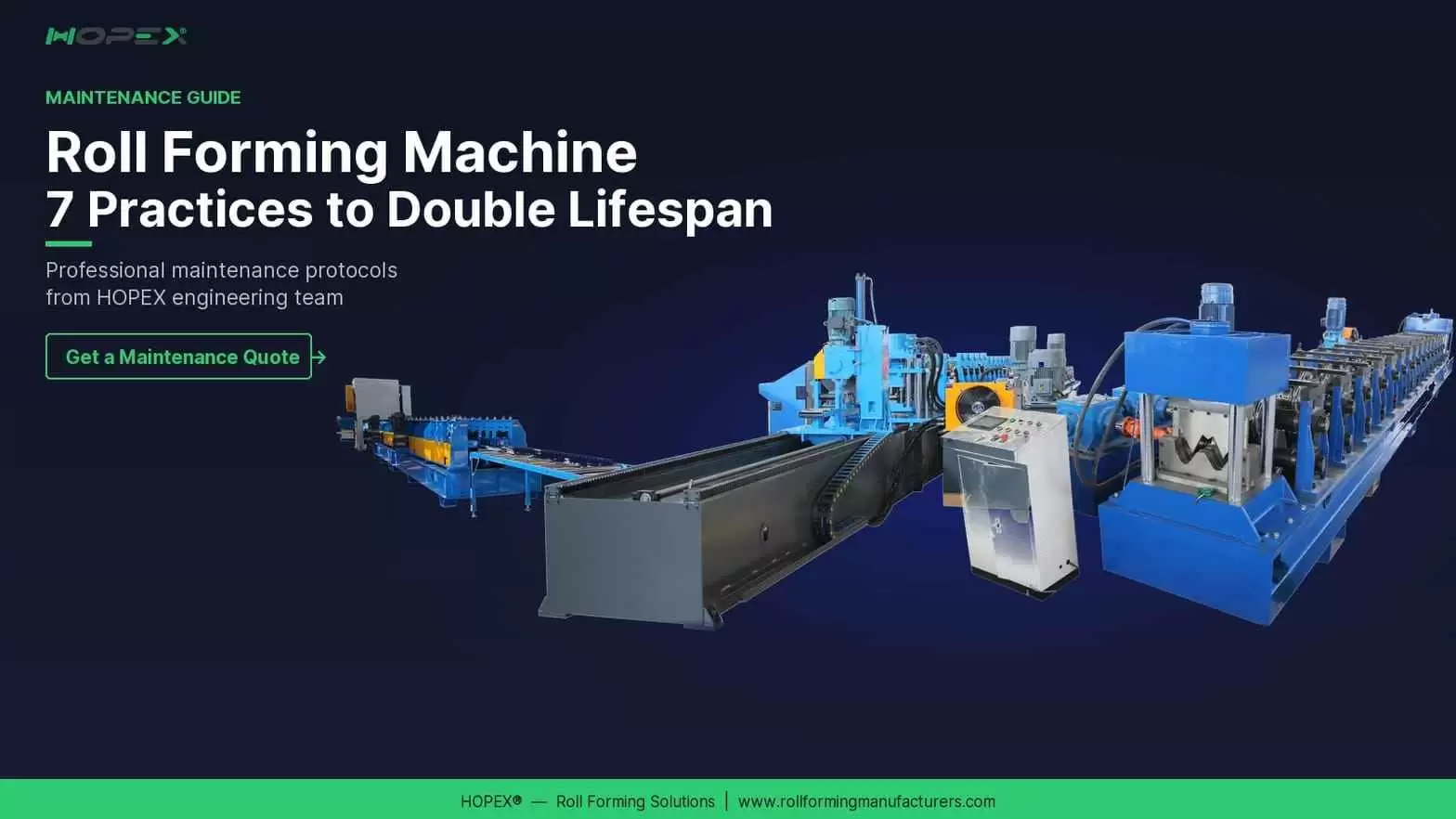
A roll forming machine is a long-cycle capital investment — a well-specified line should run productively for 15–20 years. The difference between a machine that achieves that lifespan and one that deteriorates within five years almost always comes down to maintenance discipline, not product quality.
This guide covers seven maintenance practices that our engineering team has observed separating high-performing production lines from problem operations across the clients we work with globally.
1. Daily Roll Gap Verification (Not Weekly)
Roll gap drift is the number-one source of dimensional quality problems in roll forming operations. As rollers wear and as thermal expansion occurs during operation, gaps between roll stations change — typically by 0.05–0.15 mm per day of continuous production in a new machine, stabilizing after break-in.
Practice: Measure and record roll gap at three points across the width (near-side, center, far-side) at the start of every shift. Compare against the baseline specification. Any gap that deviates >0.1 mm from specification requires adjustment before production starts.
This takes approximately eight minutes per machine. It catches profile drift before it reaches finished product — saving both material waste and the cost of customer returns.
2. Lubrication Schedule by Station Type
Not all lubrication points on a roll forming line require the same lubricant or the same interval. A common mistake is applying the same grease to every bearing and calling it done.
Using the wrong lubricant (e.g., light oil where EP2 grease is required) leads to accelerated bearing wear. The grease nipple count on a mid-size roll forming line typically runs 40–80 points — map them during installation and build the schedule into your production system.
3. Roll Profile Inspection at 500-Hour Intervals
Roller wear is gradual and invisible to the naked eye until it has already affected product quality. The most accurate method is to produce a sample profile, measure it against the master specification at 10 points along its length, and compare the dimensional histogram to the one produced at line commissioning.
If the sample falls outside ±0.3 mm on any critical dimension, the corresponding roll station needs inspection and potentially re-grinding or replacement.
At HOPEX, our cable tray and solar structure machines use Cr12MoV rollers hardened to HRC 58–62, which typically maintain specification tolerance for 5,000–8,000 hours before requiring re-grinding — compared to 1,500–2,000 hours for unhardened carbon steel rollers.
4. Electrical Panel Monthly Inspection
PLC and drive panel failures are the most disruptive form of downtime in roll forming operations because they cannot be fixed with a spare part from the shelf — they require an engineer. Prevention is straightforward:
- Check all terminal connections for looseness (vibration in forming machines is significant)
- Inspect contactors and relays for signs of arcing or heat discoloration
- Verify cooling fan operation in the drive cabinets (blocked fans lead to overheating shutdowns)
- Clear dust accumulation from frequency converters using dry compressed air
A 30-minute monthly panel inspection eliminates the majority of electrical failure events that are otherwise attributed to "random" downtime.
5. Material Coil Handling — The Upstream Damage Most Shops Ignore
Roll forming machines are damaged by bad material handling upstream far more often than by mechanical wear of the forming stations themselves. Specifically:
- Coils dropped or handled with sharp hooks damage edge coatings, creating burrs that score the leveling rollers
- Coils stored outdoors without cover accumulate moisture, leading to rust contamination that scratches roll surfaces during production
- Incorrect decoiler expansion pressure cracks the coil core, causing feed irregularities that spike punch die loads
Establish a coil handling protocol: indoor storage or covered outdoor storage, rubber-padded lifting equipment, and decoiler pressure verification against the coil ID specification before every changeover.
6. Alignment Check After Any Mechanical Impact
If a jam occurs in the production line — a strip buckle, a die misfire, a coil end bird's cage — the temptation is to clear the jam and resume production as quickly as possible. This is the wrong approach.
Any mechanical impact event should trigger a post-event alignment check:
- Check punch-to-die alignment by running a paper impression test through the punch station
- Verify roll centerline alignment using a laser level or precision straight-edge across three consecutive stations
- Check the flying shear blade gap
An undetected misalignment after an impact event typically results in gradual profile drift and eventually in a roller or die failure that would have cost far less to prevent.
7. Annual Full Disassembly and Bearing Replacement on High-Load Stations
The first three and last three forming stations on any roll forming line carry the highest loads — they do most of the bend work and experience the greatest radial forces. Bearings at these stations should be removed, inspected, and replaced annually regardless of whether they show visible wear.
The cost of a set of bearings for six stations is trivial compared to the cost of an unplanned production stoppage when a bearing races.
Summary Maintenance Calendar
Our support team can provide a machine-specific maintenance schedule for any HOPEX line. For new equipment inquiries, visit the HOPEX product range or contact us directly.
