



When mounting system manufacturers and solar project developers specify the structural rail for a solar installation, two manufacturing methods dominate the conversation: roll forming (typically steel) and aluminum extrusion. Both produce linear structural sections; both are well-established; and both have passionate advocates.
This article compares them honestly — on structural performance, production economics, supply chain risk, and application fit — so you can make the right decision for your specific market.
Method 1: Roll Forming (Steel)
Roll forming shapes flat steel strip — typically hot-dip galvanized or pre-coated — progressively through a series of roll stations to produce open or semi-closed structural profiles. Production speeds of 15–35 m/min make it among the highest-throughput linear profile manufacturing methods.
Structural performance: High-strength steel (yield strength typically 280–355 MPa for Q345) provides excellent structural efficiency at low material cost. For ground-mount applications where span lengths between posts exceed 3 m, steel roll-formed channels typically require less material than aluminum to achieve the same deflection limit.
Surface protection: Hot-dip galvanized (Z275 or Z350 coating) provides 20–30 years of corrosion protection in standard environments. For coastal or high-humidity environments, additional powder coating or PVDF coating is available.
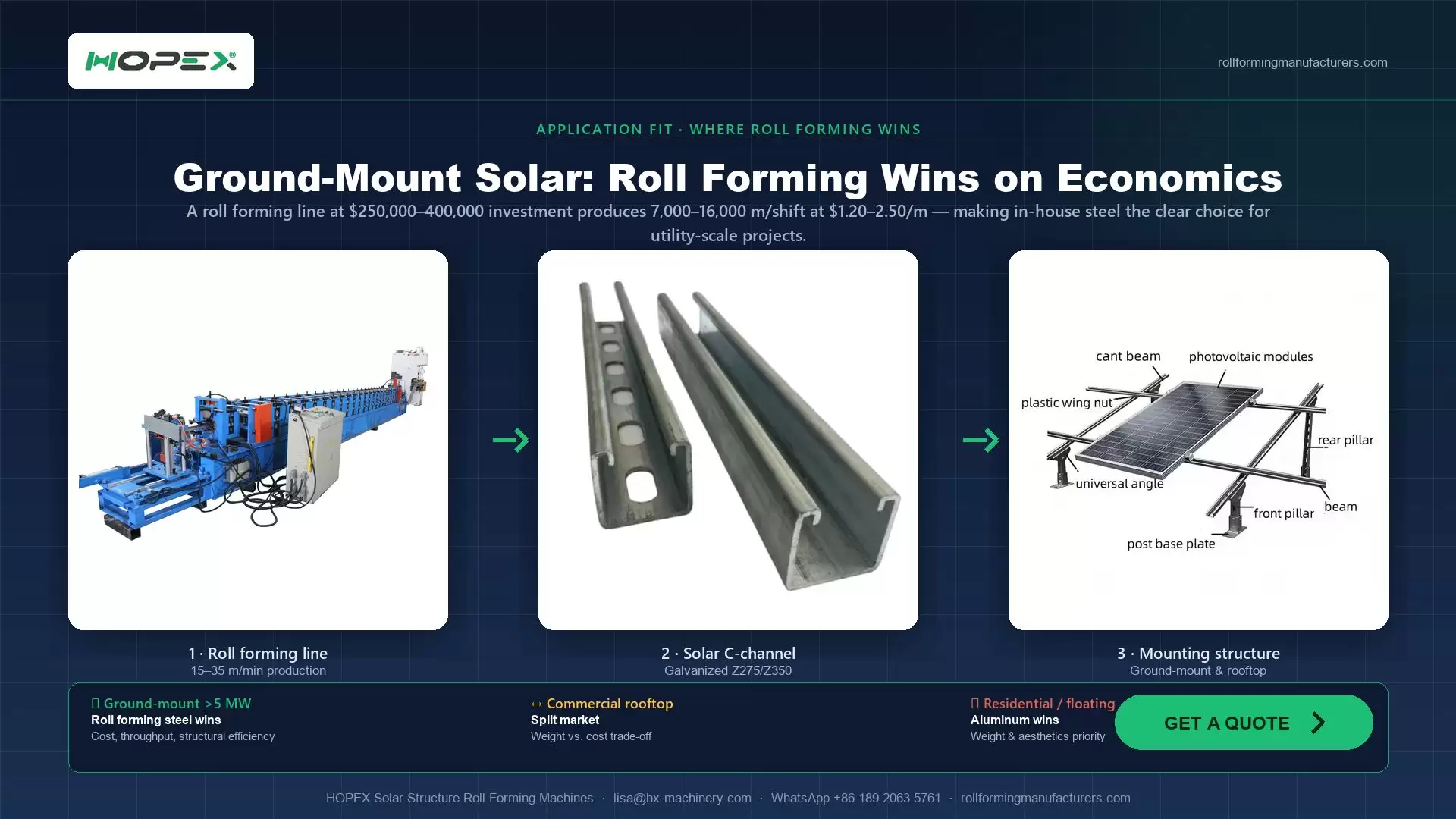
Production economics: Very favorable at volume. A roll forming line with a $250,000–400,000 investment can produce 7,000–16,000 m/shift at direct production costs of $1.20–2.50/m.
Weight: Steel is approximately 3× heavier than aluminum per unit volume. For large utility projects where transportation cost per ton is a significant project cost component, this matters.
Method 2: Aluminum Extrusion
Extrusion forces aluminum billet through a die to produce complex closed or semi-closed profiles. Unlike roll forming, extrusion can create profiles with internal void geometry (hollow sections, multi-chamber profiles) that are impossible with roll forming.
Structural performance: Standard solar extrusion alloys (6005A-T5, 6061-T6) have yield strength of 240–270 MPa — lower than the steel grades used in roll forming. Aluminum extrusions typically require greater cross-sectional area to achieve equivalent structural performance, which is why extrusion profiles tend to be heavier per unit length than the marketing implies.
Surface protection: Anodized aluminum provides excellent long-term corrosion resistance with minimal maintenance. Natural anodizing (Class 20, 20 μm minimum anodize layer) is appropriate for most solar environments; hardcoat anodizing for extreme environments.
Production economics: Extrusion is less favorable at raw throughput. A typical extrusion press produces 1,000–3,000 m/shift (vs. 7,000–16,000 for roll forming) at production costs of $2.80–4.50/m. Die cost per profile is higher ($5,000–15,000 per die) but extrusion dies are faster to produce than roll forming tooling sets.
Weight: Approximately 1/3 the weight of equivalent steel section. For rooftop installations where structural loading on the building roof is constrained, or for floating solar where buoyancy is a design consideration, this is a significant advantage.
Head-to-Head Comparison
Application Fit: Where Each Method Wins
Ground-mount utility-scale (>5 MW): Roll-formed steel wins. Volume, cost per meter, and structural efficiency all favor steel at this scale. Transportation weight disadvantage is offset by lower material cost.
Rooftop commercial (50 kW–5 MW): Split market. Weight-sensitive roof structures favor aluminum. Cost-sensitive projects favor steel.
Floating solar: Aluminum wins on weight; stainless or specialty coated steel required for water immersion resistance, significantly increasing cost.
Residential rooftop: Aluminum dominates — lower installed weight, better aesthetics, no galvanic corrosion risk with aluminum framed panels.
Carport and canopy structures: Usually steel for the primary structure, aluminum for the rail interface to panels.
For Mounting System Manufacturers: The Strategic Implication
If your target market is utility-scale ground mount — the fastest-growing solar segment globally — roll forming is the manufacturing method that will win on economics. The investment in a solar structure roll forming line pays back on volume.
If you serve multiple markets (utility + rooftop + residential), consider building roll forming capacity for your core utility volume and sourcing extrusion profiles for the smaller rooftop and residential segments where volume per order is too low to justify in-house production.
For more on solar channel manufacturing technology, contact HOPEX to discuss your specific product requirements.
