



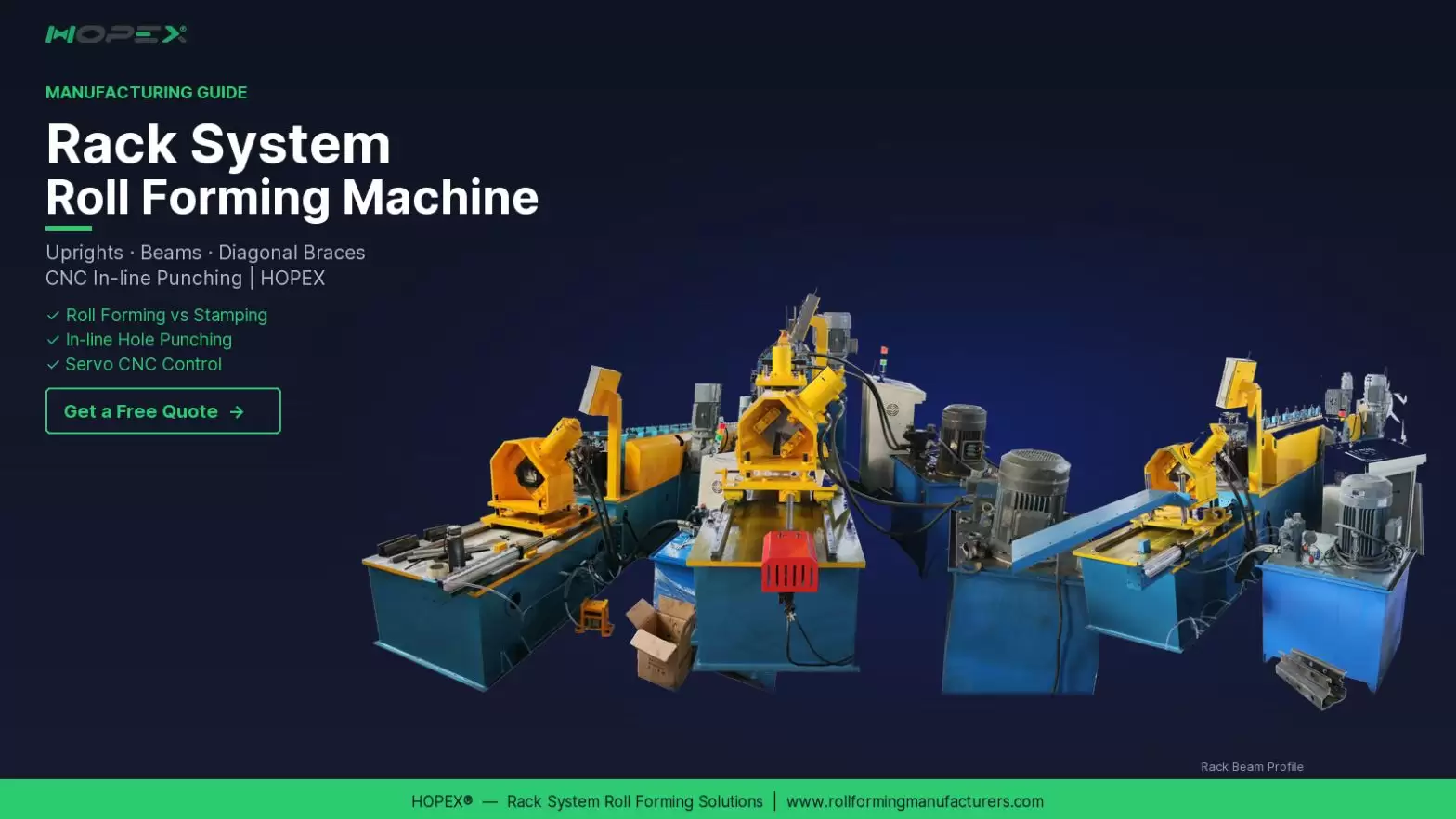
Rack System Roll Forming Machine | Storage Rack Production
If you've sourced rack uprights, beams, or braces from multiple factories, you've likely received parts made by different processes — without anyone telling you the difference. Roll forming and stamping both shape steel, but they produce very different results for structural racking components. Here's a direct comparison.
What's the Difference?
Roll forming passes a coil of flat steel through a series of contoured roll dies, progressively bending it into a constant cross-section profile. The process runs continuously — one coil in, finished uprights or beams out, cut to length on the fly.
Stamping (press forming) uses a punch and die set to deform a flat blank in a single or multi-stage press stroke. It's fast for discrete parts but less suited to long, uniform profiles.
Head-to-Head Comparison
Why It Matters for Racking
For a rack upright, consistency along 3–6 meters of length is non-negotiable. A stamped upright (produced in short sections welded together) introduces weld points — each one a potential stress concentration. Roll-formed uprights are seamless along their full length with no joins.
For beams, the hook-and-connector end detail is typically stamped or press-formed in a secondary operation — but the beam body itself benefits from roll forming for straightness and load-bearing performance.
For diagonal braces, roll forming produces the thin-wall channel profile used in bracing with excellent length consistency and tight dimensional control, which is critical for bolt-hole alignment across the full rack bay.
When Stamping Makes Sense
Stamping is still the right process for:
- Beam end connectors (safety clips, step connectors) — complex 3D geometry, short part
- Shelf decking brackets — formed sheet metal with returns
- Foot plates — heavy blanks with bolt patterns
HOPEX uses both processes strategically: roll forming for all uprights, beams, and brace profiles; stamping for connectors, clips, and anchor plates.
Buyer Takeaway
When evaluating rack suppliers, ask:
- Are the uprights roll-formed from continuous coil, or are they short stamped sections joined together?
- Is the perforation punched in-line (during forming) or in a separate press operation? In-line punching holds tighter pitch tolerances.
- What servo/CNC control does the line have? Manual or mechanical roll forming lines produce more variability.
A roll-formed upright from a well-maintained CNC line will outlast and outperform a stamped or welded equivalent under repeated loading cycles — especially relevant in warehouses with daily forklift activity.
Interested in visiting the HOPEX production facility or reviewing our line specifications?
We welcome pre-order factory audits and can provide full machine spec documentation on request.
WhatsApp: 0086 18920635761
E-mail: lisa@hx-machinery.com
