



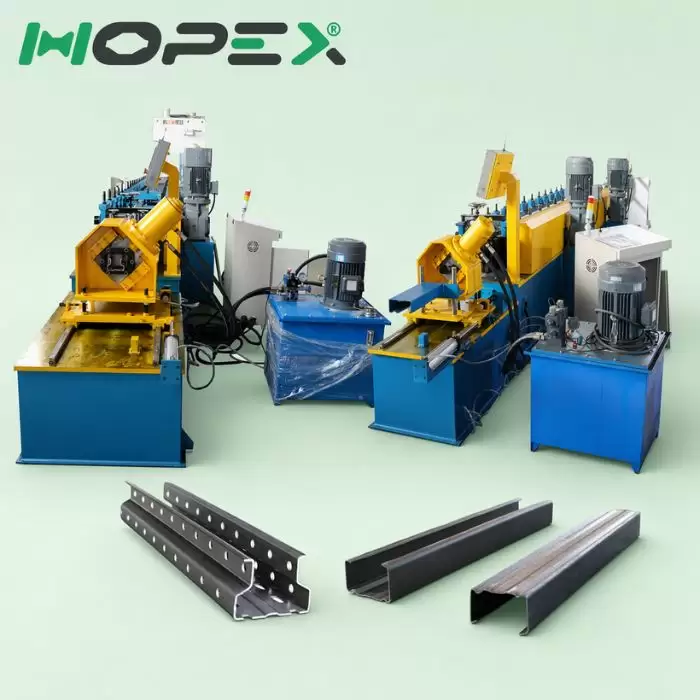
If you're in the racking or storage system business, you already know the four components that make or break your product quality: uprights, shelf beams, diagonal braces, and beam clamps. What you may not realize is how much money you're leaving on the table by sourcing finished parts instead of producing them in-house — or by running outdated equipment that limits your capacity and precision.
This article breaks down the production requirements for each of the four core racking components, the machine configurations needed, and how the right roll forming investment can turn your manufacturing operation into a competitive advantage.
Why In-House Production Wins
Before diving into each component, let's address the question every racking manufacturer eventually asks:
| Approach | Cost per unit | Quality control | Lead time | Customization |
| Import finished parts | Fixed, no margin control | Dependent on supplier | 30-60 days | Limited |
| Contract manufacturing | Medium, shared margin | Partial control | 15-30 days | Moderate |
| In-house roll forming | Lowest at scale | Full control | Days, not weeks | Unlimited |
The math is straightforward: if you're producing more than 500 tons of racking components per year, an in-house roll forming line typically pays for itself within 12-18 months — and gives you full control over quality, delivery, and customization.
Here's what you need to know about producing each component.
Component 1: Rack Uprights
What They Are
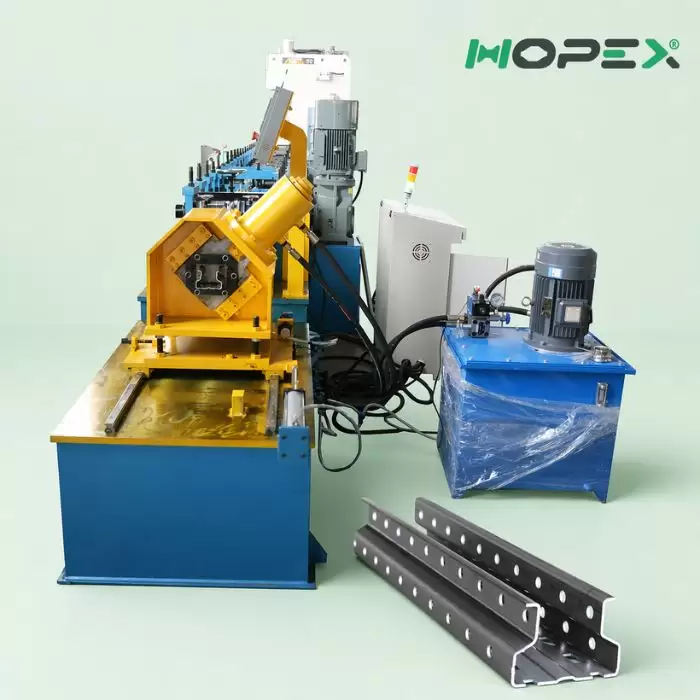
Uprights are the vertical load-bearing columns that form the structural backbone of any pallet racking system. They must withstand vertical compression loads ranging from several tons to over 20 tons per column, depending on the racking class and bay configuration.
Production Requirements
Profile complexity: Multi-bend C-section or Omega-section profiles with punched hole patterns at regular intervals (typically 50mm or 75mm pitch)
Material: High-strength cold-rolled steel, typically Q235B or Q345B, thickness 1.5-3.0mm
Critical tolerances: Hole pitch accuracy ±0.3mm, profile straightness ≤1mm/m
Key challenge: The hole punching must align precisely with the roll-formed profile — even a 0.5mm drift in pitch accumulates to visible misalignment over a 6-meter column
Recommended Machine Configuration
Upright Roll Forming Machine with integrated servo-driven punching (pre-punch or in-line punch)
PLC-controlled automatic length cutting with flying saw or hydraulic shear
Automatic stacking table for finished columns
Production speed: 8-12 m/min for standard profiles; up to 15 m/min for high-volume lines
What Sets a Good Upright Line Apart
The difference between an entry-level and a professional upright line comes down to three things: punching precision over long lengths, profile consistency from first meter to last, and quick changeover between different hole patterns and widths. A machine that requires two hours to switch between profiles costs you far more in downtime than the money you saved on the purchase price.
Component 2: Shelf Beams
What They Are
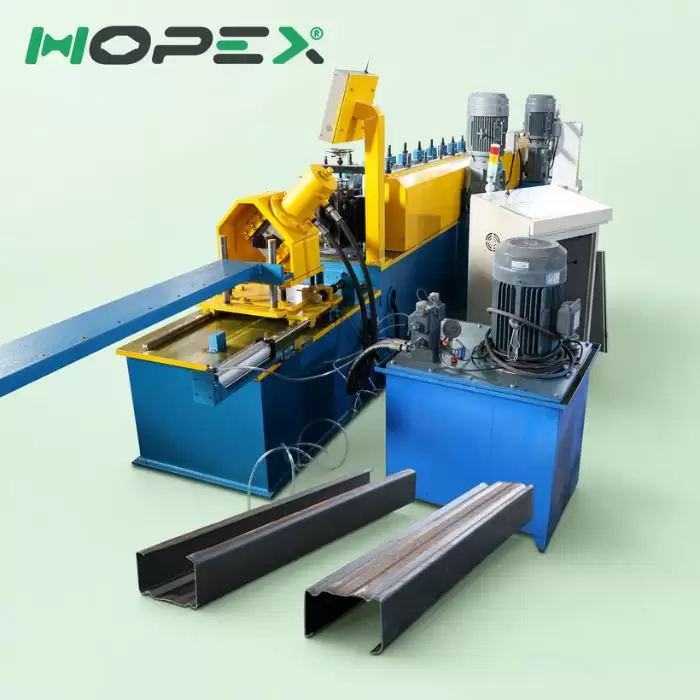
Shelf beams are the horizontal load-bearing members that connect uprights and support pallets or stored goods. Beam deflection under load is the primary failure mode in racking systems, making dimensional accuracy and material integrity non-negotiable.
Production Requirements
Profile types: Box-beam (closed section) or step-beam (open C-section with welded end connectors)
Material: Typically Q235B, thickness 1.2-2.0mm for light-duty; 2.0-3.5mm for heavy-duty pallet racking
Critical tolerances: Beam length ±1mm, end connector alignment for snap-fit with upright holes
Key challenge: The beam end connector (claw/clip) must be precisely welded or mechanically locked to match the upright hole pattern. A beam that doesn't snap in smoothly means installation delays and customer complaints.
Recommended Machine Configuration
Racking Beam Roll Form Machine with automatic punching for connector slots
Automatic end-connector insertion/welding station (optional but strongly recommended for volume production)
Two-layer automatic blanking with online correction
Production speed: 10-15 m/min
The Cost of Cutting Corners
Many manufacturers try to save money by purchasing a basic roll former and doing end-connector welding manually. At low volumes this works. At scale, manual welding becomes your bottleneck — inconsistent quality, labor dependency, and throughput capped at 200-300 pieces per shift. If you're targeting 1,000+ beams per day, invest in the integrated solution from day one.
Component 3: Diagonal Bracings
What They Are
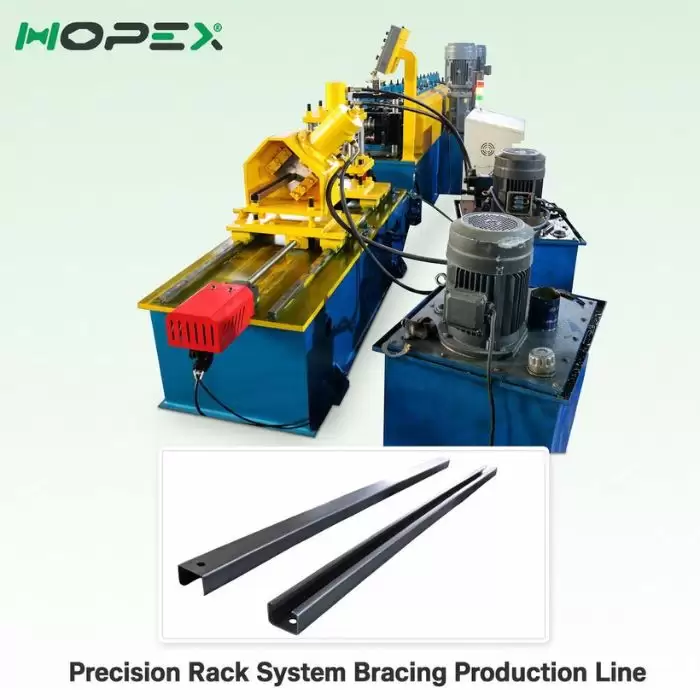
Diagonal braces provide lateral stability to racking frames, preventing collapse under horizontal loads (seismic forces, forklift impacts, wind loads in outdoor installations). They are typically lighter-gauge C or U-channel profiles with punched bolt holes at both ends.
Production Requirements
Profile: Simple C or U channel, sometimes with stiffening ribs
Material: Q235B, thickness 1.0-2.0mm
Punching: Bolt holes at both ends (fixed pattern, less complex than uprights)
Key challenge: While the profile itself is simple, braces are produced in high volumes with multiple length variants. Fast changeover between lengths is the real productivity driver.
Recommended Machine Configuration
C/U Channel Roll Forming Machine with pre-punch and post-punch capability
Servo-driven length stop for rapid length changes without manual adjustment
Option: Combined upright + brace line — a single machine line capable of producing both profiles by swapping roller sets (suited for manufacturers with diverse product mix but lower individual volumes)
Why a Dedicated Line Often Wins
The temptation is to run braces on the same line as uprights by changing tooling. But when you factor in changeover time (30-60 minutes per switch), you'll quickly find that a dedicated brace line pays for itself by keeping the upright line running uninterrupted. Run the numbers on your product mix before deciding.
Component 4: beams
What They Are
Crossbeams are the horizontal structural members that connect two upright frames across the depth of a racking bay. Together with the uprights, they form the rigid frame structure that gives the racking system its stability. Crossbeams typically feature end connectors (hooks or claws) that lock into the upright hole pattern on both ends.
Production Requirements
Profile types: Box-beam (closed rectangular section) or open C-section channel with welded end connectors
Material: Typically Q235B or Q345B, thickness 1.5-3.5mm depending on load class
Critical tolerances: Beam length ±1mm, end connector alignment ±0.3mm for snap-fit with upright holes
Key challenge: The end connector geometry must match the upright hole pattern precisely. A crossbeam that doesn't lock in smoothly means assembly delays on site and potential safety risks. The real engineering is in the consistency of the connector-to-beam weld joint under repeated loading.
Recommended Machine Configuration
Crossbeam Roll Forming Machine with automatic punching for end connector slots
Automatic end-connector insertion and welding station — essential for volume production; this station positions, inserts, and welds the connector claws to both ends of the cut beam in one cycle
Servo-driven flying cut-off for precision length control
Production speed: 10-15 m/min
The Cost of Cutting Corners
Many manufacturers try to save money by purchasing a basic roll former and doing end-connector welding manually. At low volumes this works. At scale, manual welding becomes your bottleneck — inconsistent quality, labor dependency, and throughput capped at 200-300 pieces per shift. If you're targeting 1,000+ crossbeams per day, invest in the integrated solution from day one.
Putting It All Together: Build vs. Buy Decision Matrix
| Your situation | Recommendation |
| Producing < 300 tons/year | Start with upright + crossbeam line; source shelf decks and braces externally |
| Producing 300-800 tons/year | Invest in upright line + crossbeam line with integrated connector welding; add shelf deck line and brace line as demand grows |
| Producing > 800 tons/year | Full in-house production: upright line + crossbeam line + shelf deck line + brace line — you'll recover the investment within 18 months |
| Custom/specialized racking (cold storage, automated warehouses, seismic zones) | Prioritize profile flexibility across all four components — invest in quick-change roll forming systems |
What to Look for in a Racking Roll Forming Machine Supplier
When you're evaluating suppliers, don't just compare price tags. Ask these five questions:
1.Can you show me a running machine producing the exact profile I need? — If they can't show a video of your profile being produced, walk away.
2.What is the real changeover time between profiles? — Get a commitment in writing, not a verbal estimate.
3.What grade of steel are the rollers and shafts made from? — Cr12MoV or GCr15 with heat treatment to HRC58-62 is the industry benchmark. Anything less and you're buying a maintenance headache.
4.Who provides after-sales support, and how fast can an engineer reach my factory? — For overseas buyers, this is more important than the machine spec.
5.Can you provide references from customers producing similar racking profiles? — Talk to them directly. A supplier with nothing to hide will make the introduction.
Why HOPEX?
At HOPEX, we specialize in customized roll forming solutions for the racking and storage industry. Our racking component machines are running in factories across Asia, the Middle East, and South America, producing uprights, crossbeams, shelf decks, and braces for warehouses, cold storage facilities, and automated storage/retrieval systems (AS/RS).
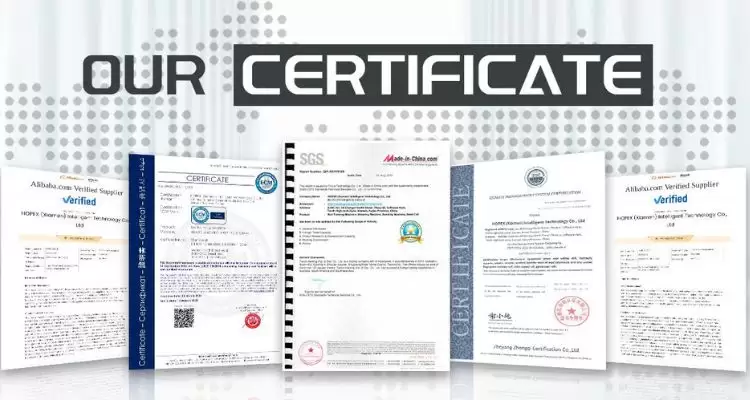
What we deliver:
1.Complete turnkey lines — from uncoiler to automatic stacking — designed around your specific profiles
2.Cr12MoV rollers with precision CNC machining, hardened to HRC60-62
3.Mitsubishi or Siemens PLC control systems with intuitive touchscreen operation
4.2-year warranty with remote support and spare parts availability
Ready to Start?
Tell us your target profiles and we'll recommend the right machine configuration — no obligation, no sales pitch.
Send us:
Your target profile drawings (upright, crossbeam, shelf deck, brace)
Your target monthly production volume
Your local material specifications
We'll respond within 24 hours with a tailored solution and quotation.
WhatsApp: 0086 18920635761
E-mail: lisa@hx-machinery.com
