



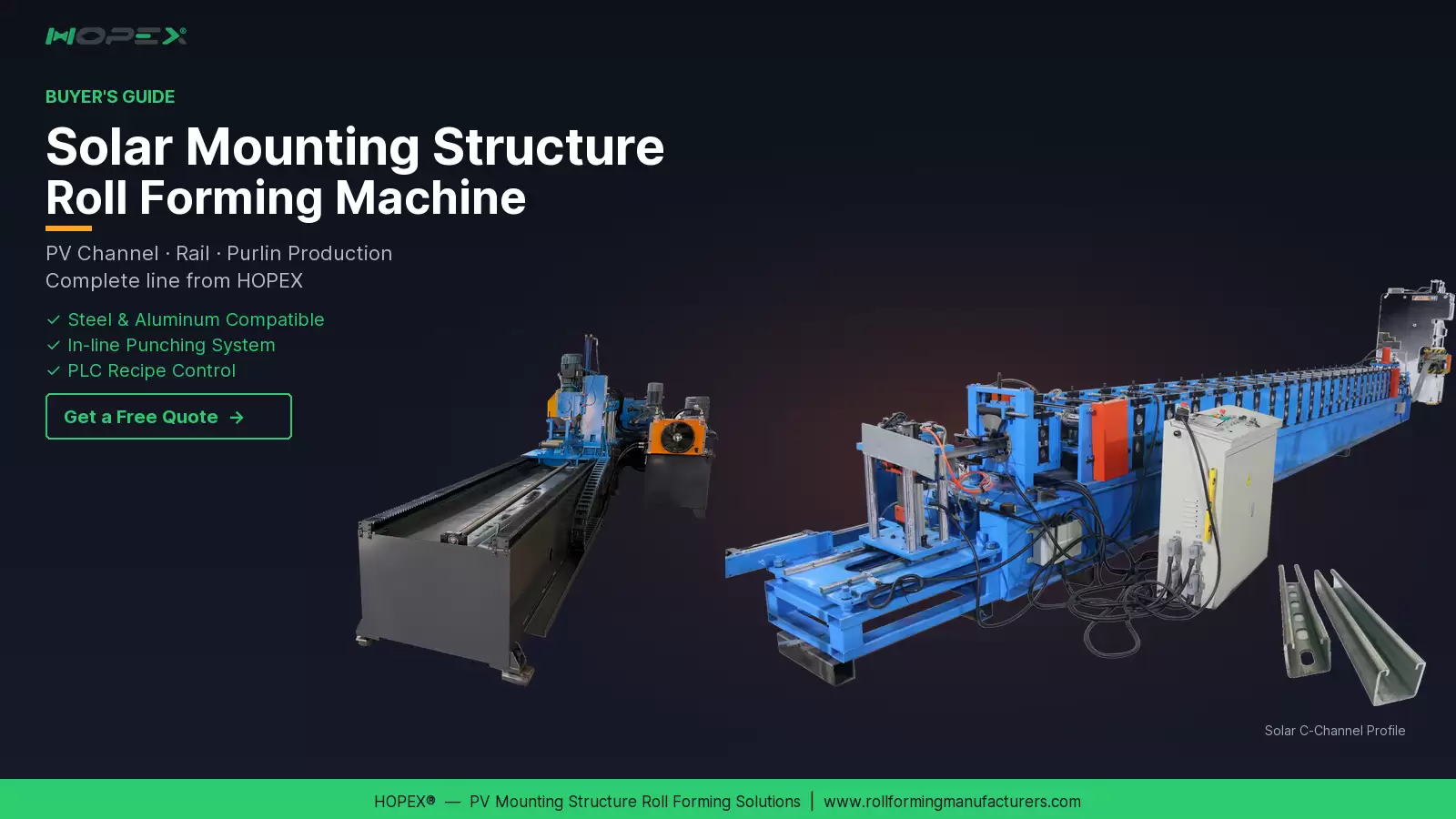
The solar industry is scaling at a pace that most manufacturing equipment sectors have never seen. Global solar installations exceeded 400 GW of new capacity in 2024, and every gigawatt of panels requires a comparable volume of structural mounting hardware — channels, purlins, brackets, and rails, all of which are produced by roll forming machines.
If you are a mounting system manufacturer, a steel fabricator considering solar as a new market, or a large EPC contractor evaluating in-house production, this guide gives you a complete picture of the equipment landscape before you commit to a capital decision.
What Does a Solar Structure Roll Forming Machine Actually Produce?
The core output of a solar structure roll forming machine is structural channel profiles — most commonly C-channel, U-channel, and Omega-profile — made from galvanized steel or aluminum coil. These profiles form:
- Ground mount rail systems: the horizontal beams that carry panel rows
- Rooftop racking channels: the attachment rails for ballasted or penetrating roof mounts
- Carport purlins: horizontal members spanning between posts in solar carport structures
- Tracker mounting rails: specialized sections for single-axis and dual-axis tracking systems
The machine transforms a metal coil (typically 0.8–3.0 mm galvanized steel or 1.0–3.0 mm aluminum) into precise structural profiles at production speeds of 15–35 m/min.
Three Machine Configurations and When to Use Each
Configuration 1: Single-Profile Dedicated Line
One machine, one profile. Optimized for maximum throughput on the highest-volume profile in your product range. Suitable when one section (e.g. a 41 × 41 mm strut channel) represents >70% of your production volume.
Best for: OEM channel suppliers with long-run contracts.
Configuration 2: Quick-Change Multi-Profile Line
A line with modular roll cassettes that can switch between 3–5 profiles within 30–45 minutes. Suitable for mounting system manufacturers who produce multiple channel sizes for different project types.
Best for: Racking system manufacturers, mid-size EPC contractors.
Configuration 3: Integrated Solar Structure Line
A line combining channel roll forming with in-line punching (for mounting holes), cutting, and optional galvanizing. Produces finished, ready-to-install channels with all mounting holes pre-formed.
Best for: Full-system manufacturers who supply complete kits to solar installers.
Our Solar Structure Roll Forming Machine range covers all three configurations — see the product catalogue for detailed specifications.
Key Specifications to Evaluate
| Specification | What to Look For |
| Material compatibility | Must handle both steel and aluminum without separate tooling |
| Production speed | 15–35 m/min for competitive economics |
| Punching system | Servo-driven for programmable hole patterns |
| Profile changeover time | Under 45 minutes for multi-profile lines |
| Dimensional tolerance | ±0.5 mm for critical dimensions |
| Control system | PLC with recipe storage for multiple profiles |
Solar Channel vs. Solar Bracket: Understanding the Difference
A common confusion in first-time buyer conversations: "channel" and "bracket" are sometimes used interchangeably, but they describe different components.
- Solar channel (or solar strut): the linear extruded or roll-formed profile used as the primary rail — carries the panels and transfers load to the mounting posts.
- Solar bracket (mounting bracket): a stamped or bent fitting that connects the channel to the post, roof, or ground anchor.
Roll forming machines produce channels; brackets are typically stamped or bent on a press brake. If your product range requires both, you need separate equipment for each — or a partner who can supply both channels and matched bracket hardware.
We cover the manufacturing process for solar channels in depth in our article: What Are the Uses of Solar Channels?
ROI Framework: When Does In-House Production Make Sense?
The break-even point for a solar channel roll forming machine investment depends on three variables:
- Current sourcing cost (price per ton of finished channel from your current supplier)
- Machine amortization (capital cost ÷ production life, typically 10–15 years)
- In-house production cost (coil + energy + labor per ton)
Rule of thumb: If you are consuming more than 300 tons of structural channels per year, in-house production typically achieves full payback within 18–24 months at current steel prices.
| Annual volume | Recommendation |
| Under 100 t/year | Source from specialized roll formers |
| 100–300 t/year | Evaluate carefully; payback depends on profile complexity |
| Over 300 t/year | In-house production almost always wins |
Questions to Ask Before You Visit a Supplier
- Can the machine process both hot-dip galvanized steel and aluminum without separate tooling sets?
- What is the actual changeover time between profiles, verified with a timer — not an estimate?
- Who supplies the PLC software, and can operators edit product recipes without calling a service engineer?
- What is the roller material specification and the hardness value after heat treatment?
- Are overseas service engineers available, and what is the SLA for on-site response?
Ready to specify your line? Visit our Solar Structure Machine product page or contact our technical team with your target profile drawings.
