



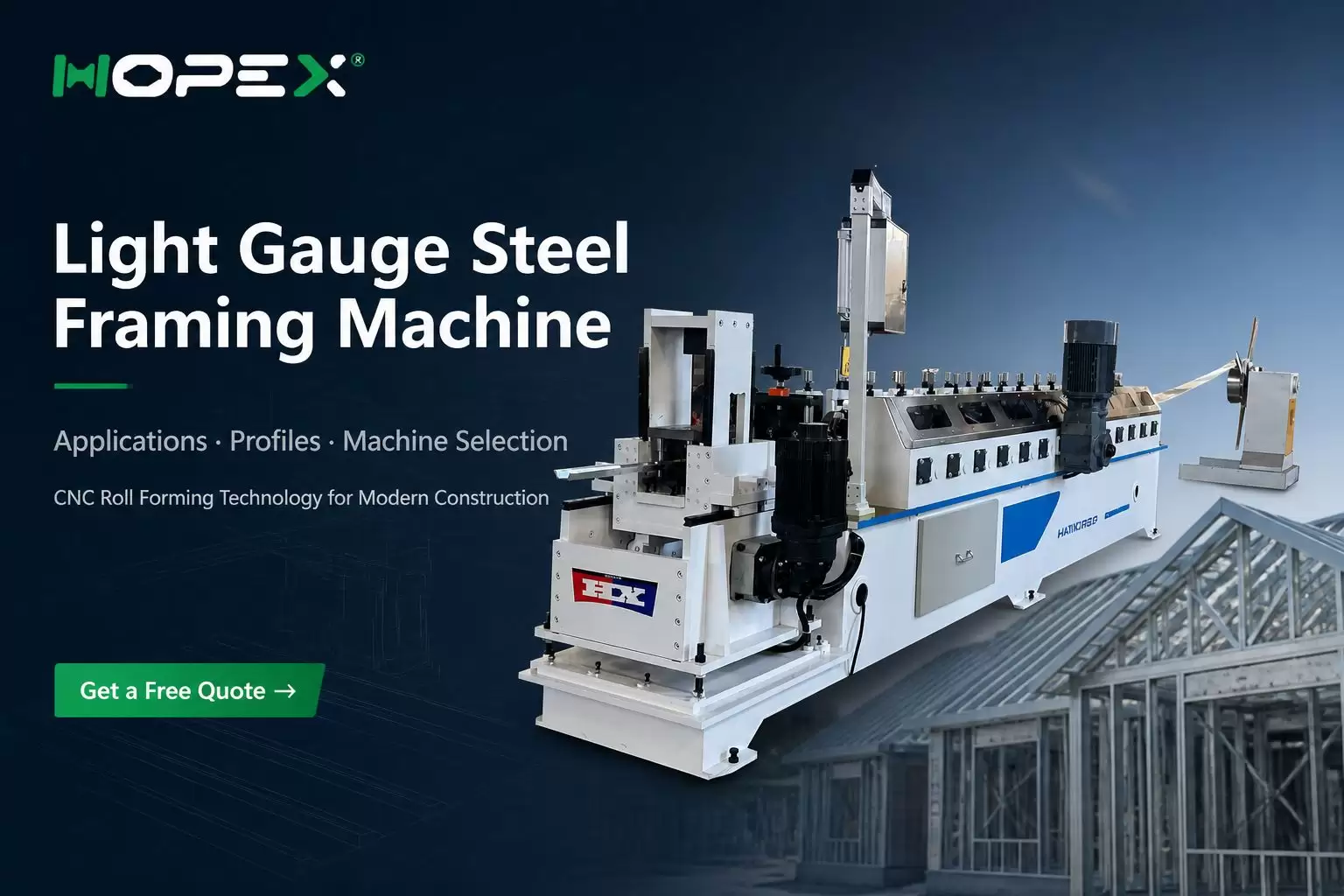
Light gauge steel framing (LGSF) has grown from a niche construction method into a mainstream structural system for residential, commercial, and modular building projects worldwide. At the heart of every LGSF manufacturing operation is a cold roll forming machine that shapes thin galvanized steel coil into structural profiles — studs, tracks, joists, and purlins — with the speed and precision that manual fabrication can never match.
This article explains the product, the machine, and how to select the right equipment for your target market.
What Is Light Gauge Steel Framing?
Light gauge steel framing uses cold-formed steel profiles — typically 0.8–3.0 mm thick galvanized steel — as the structural skeleton of a building in place of timber or heavier structural steel. The profiles are lightweight, dimensionally stable, non-combustible, and 100% recyclable.
The three core profile types produced by a light gauge steel framing machine:
C-Section Studs and Joists The primary load-bearing members. Used as wall studs (vertical) and floor/ceiling joists (horizontal). Characterized by an open C-shape with perforated web holes for service routing.
U-Track (Channel Track) The horizontal track at the top and bottom of each stud wall, into which the studs slot. Simpler profile than the stud, but must be dimensionally matched to the stud flange width.
Omega / Z / Bridging Sections Supplementary profiles used for bridging, bracing, and thermal-break applications in more complex assemblies.
Applications by Market Segment
Residential Housing (Low-Rise) In markets where timber is expensive or in short supply (Middle East, South Asia, Africa), light gauge steel framing has become the primary structural method for 1–4 story residential buildings. A single-family home requires 3–8 tons of LGSF profiles, depending on floor area and storey count.
Modular and Prefabricated Buildings The dimensional precision and transportability of LGSF panels make this system ideal for factory-built modular units: site offices, worker accommodations, classrooms, and healthcare facilities. The ability to produce profiles in exact lengths eliminates on-site cutting waste.
Commercial Steel Framing Interior partition walls, ceiling systems, and non-load-bearing facades in commercial buildings are one of the highest-volume applications globally.
Villa and High-End Residential Modern light gauge steel villa structures — our Light Villa Gauge Steel Roll Forming Machine is specifically designed for this segment — combine structural integrity with the architectural freedom of complex roof profiles and open-plan layouts.
Machine Types for LGSF Production
Manual Roll Forming Lines Entry-level, suitable for producing a limited range of fixed profiles. Operators set up profiles manually by adjusting spacers between roll stations. Lowest capital cost, but changeover between profiles takes 2–4 hours.
Automatic Programmable Lines The current industry standard. Profile dimensions (stud width, flange height, material thickness) are entered digitally, and the machine adjusts automatically via servo-driven width adjustment systems. Changeover between profiles takes 5–15 minutes.
Full Turnkey LGSF Panel Lines Combines roll forming with automated stud-cutting, track-feeding, and pneumatic or electric screw-driving to produce fully assembled wall panels in a single flow. Requires significant floor space (20–30 m line length) but outputs complete structural panels rather than individual profiles.
How to Size Your Machine Investment
Material and Quality Considerations
All LGSF profiles must be manufactured from galvanized steel meeting the appropriate coating standard (Z275 g/m² minimum for external applications is a common specification). The roll forming machine must handle the coating without damaging the galvanizing layer — which means proper roller surface finishing (polished, not rough-ground) and correct roll gap adjustment.
For structural applications, profile dimensional tolerance matters enormously. A stud with 1 mm variance in flange width will not fit correctly into the track, causing field rework. Machines with CNC width adjustment and servo-controlled forming deliver the required ±0.3 mm dimensional stability across long production runs.
Next Step
If you are evaluating LGSF manufacturing equipment, start by defining your target profile range and annual production volume — those two numbers determine everything else about the machine specification.
Learn more about our full roll forming equipment range on the HOPEX homepage or send us your profile drawings for a technical consultation at no obligation.
, and how to select the right LGSF roll forming equipment for your manufacturing operation.)