



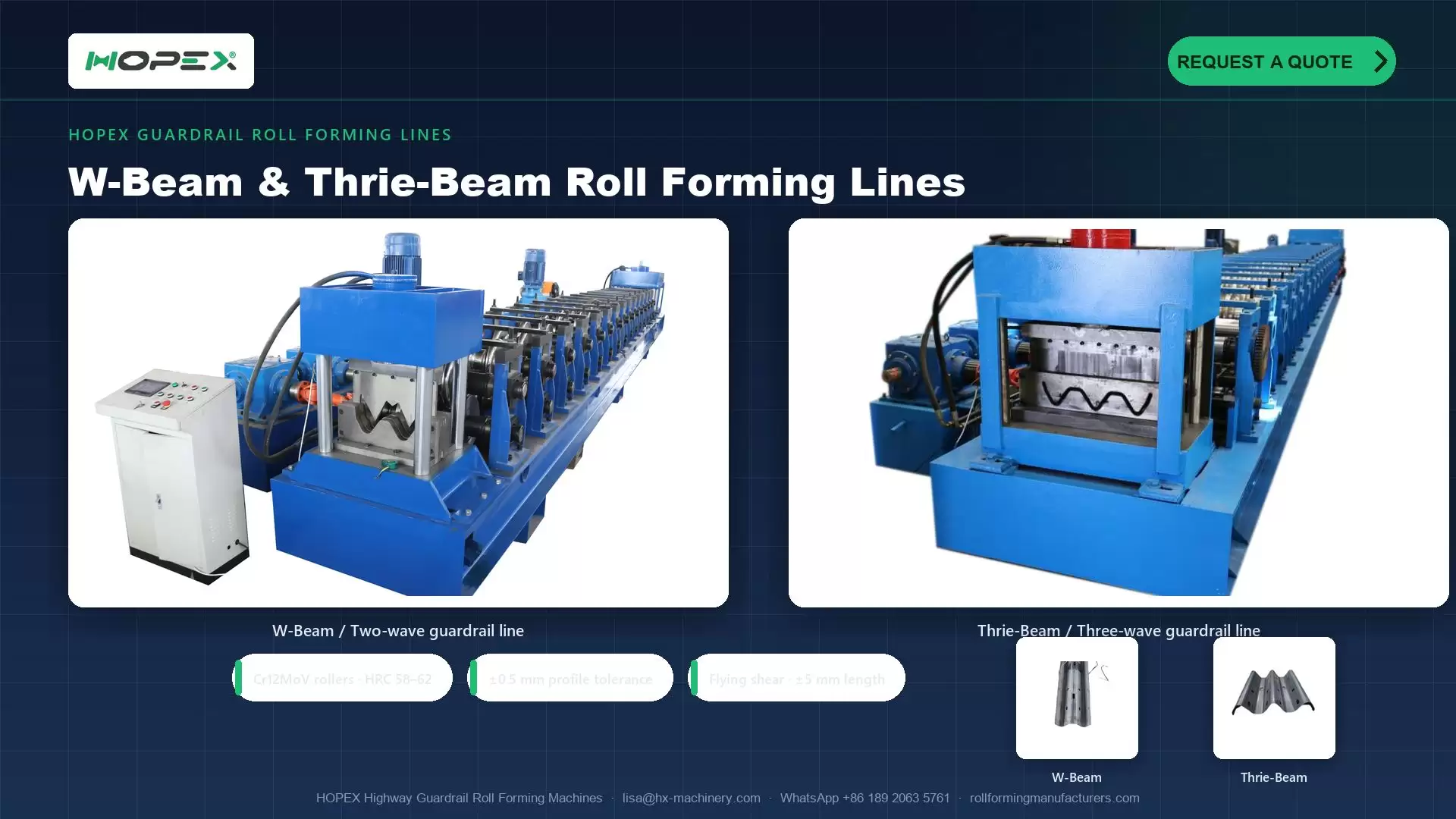
Highway guardrail is a safety-critical product regulated by national and regional standards that specify everything from steel grade and coating weight to beam profile geometry and post spacing. For guardrail manufacturers who export — or plan to — understanding the compliance landscape is not optional.
This article maps the major guardrail standards by region, identifies what they require of the manufactured product, and explains what your roll forming machine must be capable of delivering to comply.
Why Standards Compliance Drives Equipment Specification
Unlike many industrial products, highway guardrail is typically purchased directly by government road agencies or their contractors — and approved suppliers must demonstrate that their product meets the specified national standard. This approval process requires:
- A product sample tested to the standard's dimensional and material requirements
- Often a factory audit verifying that your production process is capable of consistently delivering compliant product
- In some markets, third-party certification (e.g., CE marking in Europe, AASHTO certification in the US)
The equipment you use directly determines whether you can comply. A machine that cannot hold ±0.5 mm dimensional tolerance across a full coil run cannot produce to European standards. A machine that cannot process 4.0 mm gauge steel cannot produce to heavy-duty US specifications.
Major Guardrail Standards by Region
Europe: EN 1317 The primary European standard. Key requirements:
- Profile geometry: W-Beam (type N2 containment) or Thrie-Beam (type H1/H2 containment)
- Steel grade: S235JR or S355JR (yield strength 235–355 MPa)
- Zinc coating: minimum Z350 (350 g/m² total coating mass, both sides)
- Profile dimensional tolerance: height ±2 mm, flange width ±2 mm, length ±5 mm for 4 m beam
CE marking is required for product sold in EU member states. CE marking requires a Declaration of Performance based on EN 1317 test results.
United States: AASHTO M-180 The primary US federal specification, adopted by most state DOTs. Key requirements:
- Steel grade: ASTM A1011 Grade 33 minimum (yield strength 230 MPa) or Grade 50 (340 MPa) for high-tension systems
- Zinc coating: ASTM A525, minimum G-90 coating weight (274 g/m²)
- Profile: standard W-Beam with specified dimensions (profile depth 83 mm, width 312 mm)
- Length: standard 12.5-foot (3.81 m) or 25-foot (7.62 m) sections
Some states additionally require approval under their own QPL (Qualified Products List) process, which may require separate testing even for AASHTO-compliant product.
China: GB/T 31439 The national standard for highway guardrail in China. Key requirements:
- Material: Q235 or Q345 structural steel
- Coating: hot-dip galvanized to GB/T 2518
- Profile: two-wave (W-Beam equivalent) with specified dimensions per beam grade (SB series)
- Length: 4 m standard
Middle East: Generally EN 1317 or local adaptations Saudi Arabia, UAE, and other GCC states typically specify EN 1317 or GCC-specific standards closely aligned to EN 1317. CE-marked product is accepted in most government projects.
Australia/New Zealand: AS/NZS 3845 A regionally specific standard with performance-based requirements aligned to EN 1317 containment classes. Requires product testing to AS/NZS 3845 by an accredited test facility.
What Your Roll Forming Machine Must Deliver for Compliance
The Compliance Investment Case
Many guardrail manufacturers focus on domestic market production first and treat export compliance as a future consideration. This is commercially understandable but creates a problem: the machine investment required for compliant export production is significantly higher than for basic domestic production.
If export is in your 3-year plan, specify a machine that meets export requirements from day one. The incremental cost of a higher-specification machine (heavy-frame construction, precision-machined rollers, flying shear) is typically 15–25% above a basic specification — but the cost of replacing a non-compliant machine 3 years into operation is far greater.
For production line architecture and economics, see our article on Highway Guardrail Manufacturing Production Line.
For compliance-specific equipment consultation, contact HOPEX — our engineering team can advise on machine specifications for your target export markets and connect you with certification bodies in those regions.
